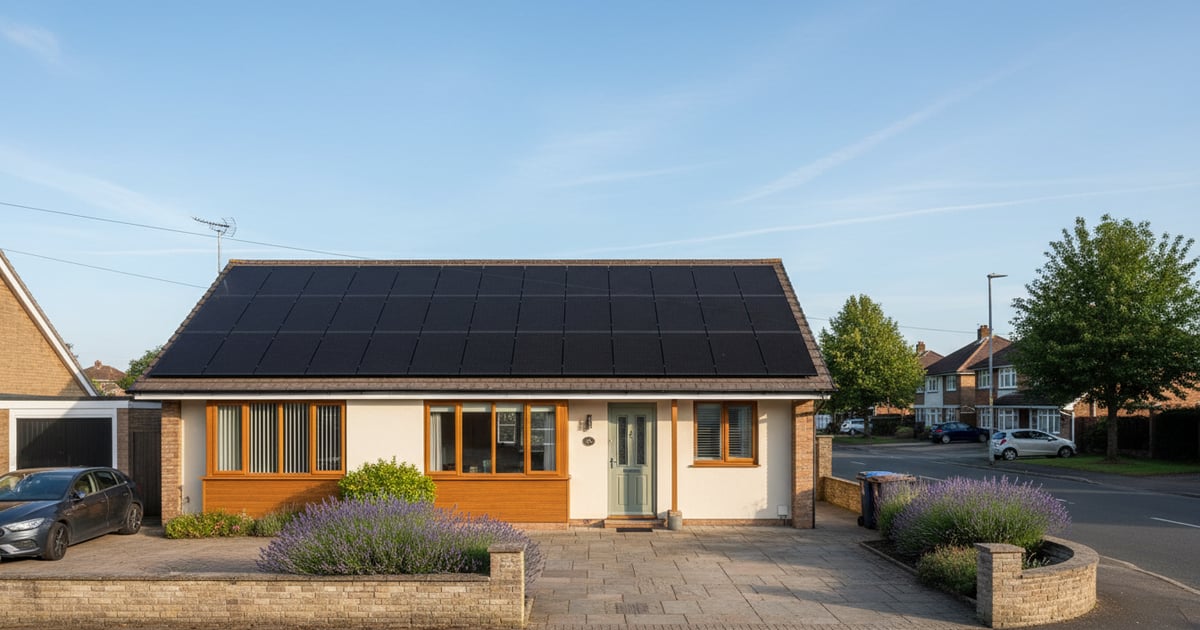
Solar Panels Costs in Wales

Solar Panels Costs in Wales

Estimates derived from UK trade benchmark data and regional labour indices, updated May 2026. Methodology →

Solar Panels in Wales often quotes below the UK mainland average, with travel and access sometimes moving rural jobs. We tie back to the national guide and spell out what that tends to mean in Wales.

In Wales, regional quotes are often below UK average, with travel affecting some rural jobs. For the full UK-wide baseline, compare with Solar Panels Cost UK.

Two ways to take action on solar panels costs

Pick the path that fits where you are — running early numbers, or pressure-testing a quote you've already got.

Typical Wales solar panels budgets

Three planning tiers for solar panels in Wales, with scope and a representative figure for each. Run your own numbers in the calculator for a tailored range.

Budget

£5,300

  • Focused essentials
  • Practical finishes
Mid-rangeMost common

£7,600

  • Balanced specification with core upgrades
  • Reliable materials
Premium

£12,000

  • Premium materials
  • Wider scope with higher coordination demands

Typical regional cost ranges

ItemCost Range
3 kW system (8–10 panels)£4,750 – £7,100
4 kW system (10–14 panels)£5,700 – £9,000
5 kW system (14–18 panels)£7,100 – £11,400
Battery storage (5–10 kWh)£3,350 – £6,700
Inverter replacement (later)£750 – £1,450

Mini solar panels cost calculator

Three quick inputs and we'll email you an indicative range. Run the full calculator for a postcode-adjusted estimate.

Typical UK home: 3-6 kWp; ~10m² roof per kWp

Unit: kWp

Email me my estimate

We'll send the indicative range straight to your inbox.

We'll email your estimate to this address regardless. Privacy policy.

What's included in Wales solar panels costs

  • System size — more panels and higher kW output cost more but can improve payback if you use the electricity.
  • Panel type and efficiency — premium panels cost more; efficiency affects output per m².
  • Roof type and access — slate, flat roofs, or difficult access can add cost.
  • Battery storage — extends self-use and backup but adds £3,500–£7,000+.
  • Location — London and the South East typically cost 10–20% more.

5 line items every fair solar panels quote should include

Use this checklist to spot missing scope before you sign — each item names what should be priced and what to ask for if it isn't.

  1. 1

    MCS certification of installer + system warranty registration

    MCS (Microgeneration Certification Scheme) certification is MANDATORY for: Smart Export Guarantee (SEG) eligibility, manufacturer warranties, mortgage compatibility. A non-MCS install means you can't sell electricity back, can't claim warranty, and may struggle to remortgage. Non-negotiable.

    Fair UK range: MCS certification adds zero direct cost — installers either are or aren't certified. Verify on the MCS register before signing.

    Ask: Are you MCS-certified, what's your MCS number, and will the system be MCS-registered post-install for SEG eligibility?

  2. 2

    Panels — brand, wattage, efficiency, and product warranty

    A fair quote names the panel brand (JA Solar, Trina, Q Cells, REC, SunPower), wattage per panel (typically 380–450W), efficiency rating (20–22% mid-range), and confirms manufacturer's product + performance warranties separately (typically 12-25 years product, 25-30 years 80% performance).

    Fair UK range: £0.45–£0.85 per watt for tier-1 panels installed; cheaper means tier-2 brands or counterfeit risk.

    Ask: What panel brand and wattage are you using, and what are the separate product and performance warranties?

  3. 3

    Inverter — brand, size, warranty separately

    The inverter converts DC to AC and is often the system's weak link. A fair quote names the inverter brand (SolarEdge, SMA, Fronius, GoodWe, Huawei), confirms it's appropriately sized (typically 80-100% of panel kWp), and states warranty (typically 10-12 years extendable to 20-25).

    Fair UK range: £800–£2,500 for inverter on a typical 4-6kWp system; hybrid inverters (battery-ready) cost £400-£800 more.

    Ask: Which inverter brand, what's its kW rating, and what's the warranty separate from the panels?

  4. 4

    Scaffolding + DNO notification + commissioning

    Most installs need scaffolding for HSE compliance (£300-£800). The DNO (Distribution Network Operator, e.g. UK Power Networks) needs notification (G98 for sub-3.68kW, G99 application for larger — can take 8-12 weeks). Commissioning includes MCS certificate generation. These are real costs that should be itemised.

    Fair UK range: £300-£800 scaffolding; G98 notification free; G99 application £150-£500.

    Ask: Is scaffolding included, who handles DNO notification, and is the system size within G98 limits or does it need a G99 application?

  5. 5

    Battery + EV charger compatibility (if applicable)

    If installing a battery now or later, the inverter must be 'hybrid' (battery-ready) or you'll need a separate AC-coupled battery (more expensive, less efficient). EV charger compatibility (Zappi, Ohme) means smart charging from solar surplus. Both decisions affect the inverter spec — get them right upfront.

    Fair UK range: Hybrid inverter £400-£800 premium over basic; EV charger compatibility usually no extra cost if smart inverter.

    Ask: If I add a battery or EV charger later, will I need to replace the inverter, or is it future-ready?

Want this run on your actual solar panels quote? Upload it and our AI Quote Checker flags missing line items, overcharges and the questions worth asking.

Check my quote

7 red flags that mean you might be overcharged on a solar panels quote

UK-specific signals — each red flag explains why it matters and the question that surfaces the truth.

  • Installer not MCS-certified

    Why it matters: Non-MCS install means: no SEG export payments (typically £150-£400/year lost), no manufacturer warranty validity, no mortgage compatibility on resale. The MCS register is public — verify before signing.

    Ask: What's your MCS number? I'll verify on mcscertified.com before proceeding.

  • 'Free solar' or 'rent your roof' offers

    Why it matters: Companies that install solar at zero cost in exchange for SEG payments (the rent-your-roof model) typically lock you into 25-year contracts with onerous terms — and your house becomes harder to sell. The maths usually doesn't add up. UK 2026 most homeowners are better off owning the system.

    Ask: If this is a rent-your-roof or PPA offer, what are the contract terms, and how does this affect resale?

  • No SAP analysis or shading assessment before quoting

    Why it matters: Solar yield depends on roof orientation, pitch, and shading. A reputable installer uses tools like Solar Edge Designer or SunCalc to model your roof's specific output. 'I'll just put 4kWp on' without analysis means under- or over-sizing.

    Ask: Have you done a shading and orientation analysis, and can you show me the predicted annual yield calculation?

  • 'Guaranteed payback in X years' with specific number

    Why it matters: Payback depends on: electricity price (volatile), your usage pattern, weather, panel degradation, inverter replacement at year 12-15. Anyone giving a precise payback figure is misleading you. Reputable installers give RANGES based on assumptions.

    Ask: Can you show me the assumptions behind the payback calculation — electricity price, usage profile, panel degradation rate?

  • Panel brand not specified, or 'tier 1' with no name

    Why it matters: There are tier-1 brands (JA Solar, LONGi, Trina, Q Cells, REC, SunPower) and there are unbranded panels from anonymous Chinese factories. Both look identical. Tier-1 brands have 25-year performance warranties; unbranded ones often disappear within 5 years.

    Ask: What's the exact panel brand, model number, and Bloomberg tier-1 rating? Can I see the product datasheet?

  • Quote includes 'lifetime' or 'forever' warranty

    Why it matters: Solar warranties are specific: product warranty (12-25 years) and performance warranty (25-30 years to specified output). 'Lifetime' is meaningless — and usually means warranty only valid while the installer remains in business.

    Ask: What's the specific product warranty period (years), separately from performance warranty? And is the warranty insurance-backed against installer insolvency?

  • No mention of scaffolding for upper-storey roofs

    Why it matters: HSE rules require proper scaffolding for roof work above 4m. Installers using ladders or harnesses only on a 2-storey property are operating illegally and unsafely. Scaffolding adds £300-£800 to the quote.

    Ask: Is scaffolding included with named provider, duration, and HSE-compliant safety setup?

Spot a couple of these on your solar panels quote? Upload it for a full red-flag scan and fair-rate comparison.

Check my quote

How to negotiate a solar panels quote

A simple framework, a verbatim script you can paste into an email or text, and the topic-specific levers that move the price.

Framework

  1. 1Get three quotes from MCS-certified installers (verify each on mcscertified.com — 30-second check). Specify: same kWp size, same panel brand range (tier-1 only), battery y/n with same kWh, same EV charger consideration. Without identical scope, comparing prices is meaningless.
  2. 2Demand itemised breakdowns covering: panels (brand + watts + count), inverter (brand + size), battery (brand + kWh, if applicable), scaffolding, DNO application, commissioning, MCS certification. Reject single-total quotes — too easy to lowball on inverter quality.
  3. 3Identify the median per major line. The total spread is usually 15-30% on identical specs — meaningful comparison. Bigger spreads usually mean different panel brands or non-MCS installers.
  4. 4Approach your preferred installer (chase MCS + recent local references over lowest price) and ask them to match the median on individual lines. Confirm the SEG export tariff and your supplier's compatibility before signing.

Verbatim script

I've had three quotes for this 4kWp system with battery. Yours is competitive overall, but the inverter line is £X above the median I've received from two other MCS-certified installers, and the panel cost is £Y above. The other quotes specify [brand] panels and [brand] inverter. Can you walk me through what's in your inverter and panel pricing that justifies the difference, or match the median if you're using comparable spec? Also confirm the SEG paperwork is included.

Topic-specific levers

  • Battery upgrade timing: install solar now without battery (saves £2,000+), add battery in 1-2 years when prices drop and your usage data is clear. Future-proof by ensuring inverter is hybrid.
  • VAT 0% rate: solar installs are 0% VAT until March 2027 (extended scheme). Confirm this in writing on quotes — a 20% VAT add-on at invoice time is a £600+ surprise on a £3,000 install.
  • Bird/squirrel mesh: many quotes don't include panel-edge mesh (£200-£400 extra). Squirrels nest under panels and chew cables — adding mesh is cheap insurance.
  • Smart export tariff selection: Octopus Outgoing Fixed (15p/kWh), E.ON NextExport (16.5p/kWh) currently lead. Check rates BEFORE installing — installer can do this with you.
  • Off-peak install booking: November-February installers have gaps; bookings then often save 10-15% vs spring rush.

Want to know which line items on your solar panels quote are above market before you negotiate? Upload it for a fair-rate comparison.

Check my quote

10 questions to ask before hiring a MCS-certified solar installer

Vet on competence, insurance, paperwork and process — not price alone. Each question spells out the answer you want and why.

  1. 1. What's your MCS number, and is it for both panels and battery (separate certifications)?

    Why it matters: MCS is mandatory for SEG eligibility and warranty validity. Verify the number on mcscertified.com — takes 30 seconds. Battery installations may need separate MCS battery certification.

  2. 2. Are you a member of RECC (Renewable Energy Consumer Code) or HIES?

    Why it matters: RECC and HIES provide consumer protection codes specifically for renewable energy. Membership means a deposit protection scheme, mediation, and insurance-backed warranties. Strong signal.

  3. 3. Can you show me 2-3 recent local installs (last 12 months) with homeowner contact details?

    Why it matters: Solar installs have a long failure tail — issues appear at 6-18 months. Recent local references let you visit installations and ask homeowners about post-install experience.

  4. 4. Which panel brand and model are you proposing, and is it tier-1 Bloomberg-rated?

    Why it matters: Tier-1 brands (JA Solar, LONGi, Trina, Q Cells, REC, SunPower) have 25-year performance warranties from manufacturers who'll still exist in 25 years. Tier-2 brands often disappear within 5 years.

  5. 5. What's the inverter brand, size, and warranty — and is it hybrid (battery-ready)?

    Why it matters: Inverter is the system's weakest link (typically replaced at 12-15 years). Hybrid inverters cost slightly more but enable battery integration without inverter replacement.

  6. 6. Have you done a shading and orientation analysis, and can you share the yield prediction?

    Why it matters: Reputable installers use SunCalc or PVGIS to model your specific roof. Yield prediction in kWh/year is the basis for any payback calculation. Vague answers mean guesswork.

  7. 7. Will you handle the DNO notification (G98 or G99 application)?

    Why it matters: G98 (sub-3.68kW per phase) is a notification post-install. G99 (larger or 3-phase) requires application BEFORE install — taking 4-12 weeks. Reputable installers manage this; cowboys leave it to you.

  8. 8. What's the system warranty, separate from the panel and inverter manufacturer warranties?

    Why it matters: Three layers: panel manufacturer warranty (12-25 years), inverter warranty (10-12 years), installer workmanship warranty (typically 5-10 years). Insurance-backed installer warranties protect against installer insolvency.

  9. 9. Is the install at 0% VAT, and have you confirmed in writing?

    Why it matters: Solar is 0% VAT until March 2027. Some installers still quote at 20% then 'forget' to apply the 0% rate. Get it in writing on the quote — a £600+ saving on a £3,000 install.

  10. 10. Are you VAT registered, and what's your public liability cover?

    Why it matters: VAT registration matters for invoice and warranty enforcement. Public liability of £2M minimum is industry norm; £5M for installs over £15k. Ask to see certificates.

Already chosen a MCS-certified solar installer and got a quote? Run it through our Quote Checker before you commit.

Check my quote

Ready to act on your solar panels project?

Whether you're still scoping or already comparing builders, the next step is one click away.

Compare other regions

Other renovation costs in Wales

All Wales renovation costs

Frequently asked questions

Want the UK-wide picture for solar panels?

See national cost ranges, scenarios and timelines without the regional adjustment.

Compare solar panels costs across the UK