Bathroom Renovation Costs in London

Bathroom Renovation Costs in London

Estimates derived from UK trade benchmark data and regional labour indices, updated May 2026. Methodology →

Bathroom Renovation in London typically lands above the UK-wide average for the same spec. We start from our national guide ranges and reflect the labour and logistics pressure you usually see in the capital.

In London, labour and logistics costs are typically highest across UK regions. For the full UK-wide baseline, compare with Bathroom Renovation Cost UK.

Two ways to take action on bathroom costs

Pick the path that fits where you are — running early numbers, or pressure-testing a quote you've already got.

Typical London bathroom renovation budgets

Three planning tiers for bathroom renovation in London, with scope and a representative figure for each. Run your own numbers in the calculator for a tailored range.

Budget

£6,100

  • Existing suite replaced like-for-like
  • Walls part-tiled
  • Vinyl floor fitted
Mid-rangeMost common

£12,200

  • Full family bathroom refit with better shower valve
  • Porcelain tile in wet areas
  • Improved ventilation
Premium

£24,000

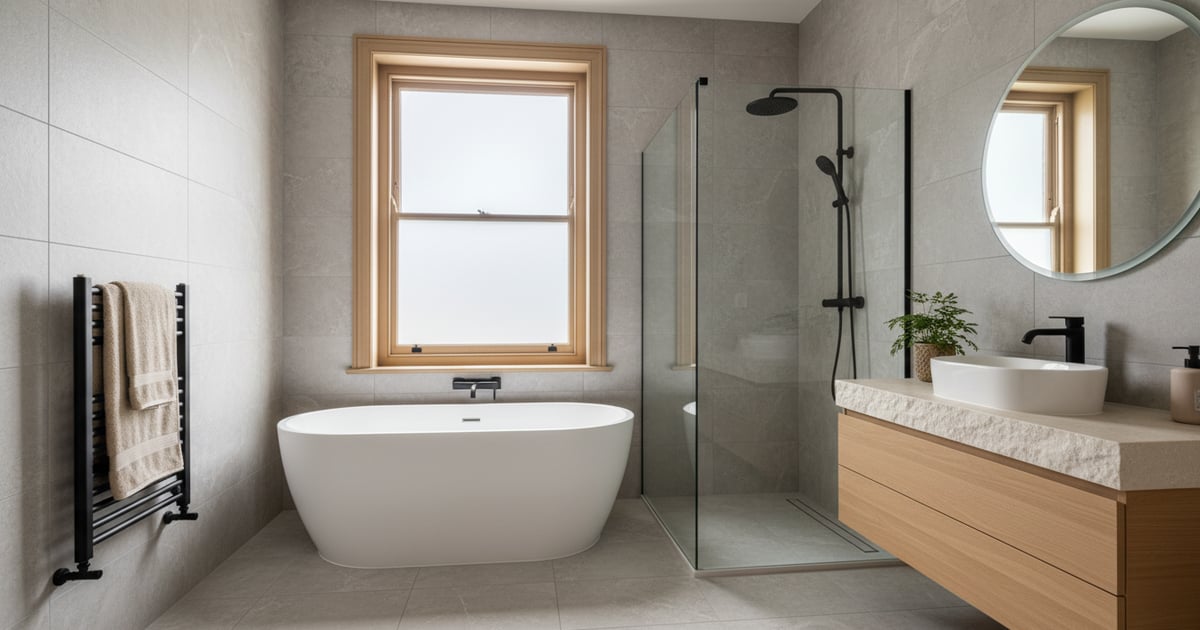
  • Layout reconfigured for walk-in shower
  • Freestanding bath
  • Premium tile throughout

Typical regional cost ranges

ItemCost Range
En-suite refresh (suite + tiles)£1,850 – £4,900
En-suite full refit£4,250 – £8,500
Basic suite replacement£2,450 – £9,800
Full bathroom refit£4,900 – £18,300
Wet room conversion£6,100 – £22,000

Indicative range: £500£1,450 per m².

Mini bathroom cost calculator

Three quick inputs and we'll email you an indicative range. Run the full calculator for a postcode-adjusted estimate.

Floor area — typical UK family bathroom is 5–8 m², en-suite 3–4 m².

Unit:

Email me my estimate

We'll send the indicative range straight to your inbox.

We'll email your estimate to this address regardless. Privacy policy.

What's included in London bathroom renovation costs

  • Size of the bathroom — en-suites and compact bathrooms are cheaper than family bathrooms; less tiling and often simpler plumbing.
  • Quality of sanitaryware — budget brands vs. premium brands like Duravit or Villeroy & Boch.
  • Plumbing changes — moving pipework or soil stacks adds significant cost.
  • Tiling coverage and material — natural stone costs more than ceramic.
  • Accessibility features — walk-in showers, grab rails, and level-access trays.
  • Location — London and the South East typically cost 15–25% more than the national average.
  • Underfloor heating — electric mats add £300–£600, wet systems cost more.

5 line items every fair bathroom quote should include

Use this checklist to spot missing scope before you sign — each item names what should be priced and what to ask for if it isn't.

  1. 1

    Strip-out, waste removal and skip hire

    Lifting the old suite, ripping tiles off walls, taking up floor coverings and getting it all off-site. UK skip hire alone is £180–£320 for a 4-yard skip including permit. A fair quote names skip size, hire days and disposal route — not just 'rip-out'.

    Fair UK range: £250–£600 for a typical 5–8 m² bathroom, including skip hire and disposal.

    Ask: What size skip is included, how long is it on hire, and where will it sit (driveway or road permit)?

  2. 2

    First-fix plumbing and any pipework moves

    Soldering or push-fit copper, waste pipe re-runs, isolation valves, shower valve roughs and any soil pipe alterations. UK Water Regulations 1999 apply — the plumber should be WaterSafe or APHC registered. Moving the toilet position alone can add £400–£900 because of the soil stack work.

    Fair UK range: £600–£1,800 for like-for-like; £1,500–£3,500+ if relocating WC, basin or bath.

    Ask: Is your plumber WaterSafe-approved, and can you list every pipe being moved with a price for each?

  3. 3

    Tanking and waterproofing in wet zones

    Behind shower trays and on wet-room floors, you need a proper tanking membrane (BAL WP1, Mapei Mapegum WPS or similar) — not just silicone and prayer. This is the single most-skipped step in cheap quotes and the #1 cause of leaks into the room below within 24 months.

    Fair UK range: £200–£500 for a standard shower; £600–£1,200 for a full wet room.

    Ask: Which tanking system are you specifying, and will you provide the manufacturer's installation warranty?

  4. 4

    Tiling — supply, prep and fit (with grout/silicone spec)

    Should name the tile (brand, range, size in mm), the adhesive grade (S1 flexible for porcelain), grout colour and silicone brand. m² coverage with 10–15% waste allowance — diagonal or large-format pushes waste higher. UK fitting labour for porcelain is typically £40–£70/m².

    Fair UK range: £70–£150/m² for ceramic supply + fit; £100–£220/m² for porcelain or natural stone.

    Ask: Can you list the exact tile, adhesive grade and grout, and what waste percentage have you priced?

  5. 5

    Electrics — Part P notification and IP-rated fittings

    Bathrooms are 'special locations' under BS 7671. Any new circuit, fan, downlight or shaver point must be Part P notified — your fitter or their electrician should issue an EIC (Electrical Installation Certificate) and a Building Regs compliance cert from a competent persons scheme (NICEIC, NAPIT, ELECSA). No certificate = no compliance and an issue at sale.

    Fair UK range: £200–£600 for fan + lights + shaver socket on existing supply; more for a new circuit.

    Ask: Will I receive an EIC and a Part P Building Regs compliance certificate signed by a registered electrician?

Want this run on your actual bathroom quote? Upload it and our AI Quote Checker flags missing line items, overcharges and the questions worth asking.

Check my quote

7 red flags that mean you might be overcharged on a bathroom quote

UK-specific signals — each red flag explains why it matters and the question that surfaces the truth.

  • Single 'supply and fit' line with no breakdown of suite, tiles, labour or skip

    Why it matters: Without a breakdown you can't compare quotes properly or see where the markup sits — and you've no leverage to challenge any single item. KBSA and BiKBBI member quotes always itemise; the absence is a tell.

    Ask: Can you re-issue this with separate lines for suite, tiles, labour, plumbing, electrics, tanking and waste removal?

  • No mention of WaterSafe, APHC or Gas Safe (if a gas boiler relocation is involved)

    Why it matters: Plumbing in a bathroom touches potable water and (sometimes) gas. WaterSafe accreditation is the UK consumer scheme for water regs compliance; Gas Safe is legally required for any gas work. Absence doesn't always mean rogue trader, but it shifts the risk to you.

    Ask: Which plumbing scheme are you registered with, and can you send your registration number so I can verify on the WaterSafe/Gas Safe website?

  • No tanking or waterproofing line item where there's a shower

    Why it matters: Silicone alone isn't waterproofing. A proper tanking system (membrane or liquid-applied) is the only thing that stops a slow leak destroying the ceiling below. If it's missing from the quote, the fitter is either skipping it or planning to charge it as an extra mid-job.

    Ask: Where is the tanking system in this quote, what brand are you using, and will you photograph it before tiling?

  • Electrical work bundled into 'fitting' with no Part P certificate offered

    Why it matters: Without a Part P-compliant cert, you're technically holding non-notified electrical work — which surfaces during conveyancing when you sell. A reputable fitter has a named electrician on the job and issues paperwork.

    Ask: Who is the electrician on this job, what scheme are they registered with, and will the EIC and Building Regs cert be in my name?

  • More than 30% deposit requested, or full payment before completion

    Why it matters: UK consumer norm for bathrooms is 10–25% deposit (often timed to suite delivery), staged payments at first-fix and second-fix, balance on snag completion. Big upfront asks usually signal cash flow problems — and if they go bust, your money is gone.

    Ask: Can we agree a payment schedule of 20% on start, 30% at first-fix complete, 30% at second-fix, balance on signed snagging list?

  • Vague timeline ('around 2 weeks') with no day-by-day programme or named tile delivery date

    Why it matters: Bathrooms involve multiple trades in sequence — strip-out, plumber, electrician, tiler, decorator. Without a programme, slip on day 3 cascades into weeks. UK tile suppliers routinely have 1–3 week leads on porcelain ranges; not knowing the delivery date means delays you can't plan around.

    Ask: Can you send me a day-by-day programme, including tile and suite delivery dates and which day each trade is on site?

  • No public liability insurance certificate offered, or vague answer when asked

    Why it matters: Bathroom work creates real damage risk: floods downstairs, broken tiles in transit, dropped suites cracking floor screed. UK industry norm is £2M minimum public liability. If they can't show the certificate, your buildings insurance may not cover their mistakes.

    Ask: Can you email me a copy of your current public liability insurance certificate showing the cover level and expiry date?

Spot a couple of these on your bathroom quote? Upload it for a full red-flag scan and fair-rate comparison.

Check my quote

How to negotiate a bathroom quote

A simple framework, a verbatim script you can paste into an email or text, and the topic-specific levers that move the price.

Framework

  1. 1Lock the scope in writing first: bathroom dimensions, suite spec (brand and product code), tile spec (brand, range, m² coverage), and whether layout changes. Identical scope is the only basis for a fair comparison.
  2. 2Get three written quotes from KBSA or BiKBBI members where possible — local recommendations from a Facebook community group beat random Checkatrade picks.
  3. 3Compare line by line, not bottom line. Build a simple table: strip-out, plumbing, electrics, tiling labour, tile supply, suite supply, tanking, decorating. The cheapest total often hides a missing line.
  4. 4Go back to your preferred fitter (rarely the cheapest — chase reliability) with the median figure on the 2–3 lines where they're highest. Ask for justification or a price match on those specific items only.

Verbatim script

Thanks for the quote — really appreciate the detail. I've had two other quotes from KBSA-registered fitters for the same scope and yours is competitive overall, but it's £X above the others on tiling labour and £Y above on the suite supply. Both other quotes specified the same Roca In-Tank or whatever the suite is. Could you walk me through what's included in those two lines that justifies the difference, or match the median if it's the same spec? Happy to commit this week if we can get the numbers aligned.

Topic-specific levers

  • Supply your own suite from Victoria Plum, Soak.com or Bathstore — fitters often mark up sanitaryware 15–30%. You typically save £400–£900 on a mid-range suite, but check the fitter will warranty their installation if they didn't supply.
  • Stay like-for-like on plumbing positions. Moving the toilet 1m can add £600+ because of soil stack work; moving the basin to the other wall adds another £300–£500. Keeping layout flat is the single biggest lever.
  • Choose ceramic tiles instead of large-format porcelain — same look from 1m away, half the fitting labour and half the material cost. £600–£1,500 saving on a typical bathroom.
  • Bundle decorating into the fitter's scope rather than bringing in a separate decorator afterwards — saves a return visit charge and the fitter's painter rate is usually cheaper than a standalone trip.
  • Time it for January–February or August. UK bathroom fitters' diaries are full October–December (pre-Christmas push) and April–June (post-tax-return spending). Quiet months are negotiable by 5–12%.

Want to know which line items on your bathroom quote are above market before you negotiate? Upload it for a fair-rate comparison.

Check my quote

10 questions to ask before hiring a bathroom fitter

Vet on competence, insurance, paperwork and process — not price alone. Each question spells out the answer you want and why.

  1. 1. Are you a KBSA (Kitchen Bathroom Bedroom Specialists Association) or BiKBBI (British Institute of Kitchen, Bedroom & Bathroom Installation) member, and can I see the registration?

    Why it matters: Both schemes vet members for competence, insurance and consumer code compliance. Membership doesn't guarantee perfection but it gives you a route to mediation if things go wrong. Absence isn't disqualifying but raises the bar on other checks.

  2. 2. Is your plumber WaterSafe-approved, and your gas engineer Gas Safe registered (if any gas work)?

    Why it matters: WaterSafe is the UK accreditation body for plumbers complying with the Water Regs 1999. Gas Safe is a legal requirement for any gas appliance work. Both registers are publicly searchable — verify before signing.

  3. 3. Who is the electrician on this job, what competent persons scheme are they registered with, and will I receive a Part P Building Regs compliance certificate?

    Why it matters: Bathrooms are special locations under BS 7671. Part P notification via NICEIC, NAPIT or ELECSA is mandatory for new circuits. Without paperwork, you'll have problems at sale and your home insurance may push back on any electrical fire claim.

  4. 4. Can I see two recent (last 6 months) bathroom references in this region with photos and a phone number to call?

    Why it matters: Recent local references are the strongest quality signal. Old references or photos with no contact details are weaker — and reputable fitters happily provide them.

  5. 5. What tanking system do you use behind showers and in wet rooms, and is it BBA-certified or installed under manufacturer warranty?

    Why it matters: Schlüter-KERDI, BAL WP1, Mapegum WPS — these are the recognised systems. A vague 'we waterproof it' answer is a red flag; the wrong system or no system means leaks within 2 years.

  6. 6. What's your payment schedule and what happens if you miss the agreed completion date?

    Why it matters: Fair UK norm: deposit ≤25%, staged payments tied to milestones, balance on snag sign-off. Reputable fitters offer a goodwill day-rate reduction or fixed compensation for serious overruns.

  7. 7. What's your written workmanship warranty, and is it backed by an insurance scheme like IWA or QANW?

    Why it matters: Self-issued warranties are only as strong as the business behind them. An insurance-backed warranty (Independent Warranty Association, Qualitymark Protected) survives even if the fitter goes bust. UK norm is 2–6 years on workmanship.

  8. 8. Do you carry public liability insurance at £2M minimum, and can I see the current certificate?

    Why it matters: Bathroom work risks include floods affecting your home and neighbours below. £2M is the UK industry standard; ask for the certificate, not the verbal answer. Check the expiry date covers your project end.

  9. 9. Are you VAT registered, and will I get a proper VAT invoice with your VAT number on it?

    Why it matters: VAT registration signals turnover above £90k (2026) — i.e. an established business. A proper invoice protects you under the Consumer Rights Act and lets you enforce warranty claims. Cash-only deals forfeit consumer protection.

  10. 10. How do you handle snagging — what's the process if I find issues in the first 30 days, and how quickly do you respond?

    Why it matters: Snags are normal on every bathroom. The question is whether the fitter has a defined process (return visit within X days, named contact, list signed off) or treats them as awkward favours. The answer reveals the working culture.

Already chosen a bathroom fitter and got a quote? Run it through our Quote Checker before you commit.

Check my quote

Ready to act on your bathroom project?

Whether you're still scoping or already comparing builders, the next step is one click away.

Compare other regions

Frequently asked questions

Want the UK-wide picture for bathroom renovation?

See national cost ranges, scenarios and timelines without the regional adjustment.

Compare bathroom renovation costs across the UK