£2,800
- Focused essentials
- Practical finishes
Estimates derived from UK trade benchmark data and regional labour indices, updated May 2026. Methodology →
Underfloor Heating in London typically lands above the UK-wide average for the same spec. We start from our national guide ranges and reflect the labour and logistics pressure you usually see in the capital.
In London, labour and logistics costs are typically highest across UK regions. For the full UK-wide baseline, compare with Underfloor Heating Cost UK.
Pick the path that fits where you are — running early numbers, or pressure-testing a quote you've already got.
Three planning tiers for underfloor heating in London, with scope and a representative figure for each. Run your own numbers in the calculator for a tailored range.
£2,800
£4,900
£10,600
| Item | Cost Range |
|---|---|
| Electric UFH (per m²) | £50 – £100 |
| Wet UFH (per m²) | £100 – £150 |
| Single room electric (15m²) | £1,000 – £1,850 |
| Ground floor wet (50m²) | £4,900 – £9,800 |
| Manifold and controls | £250 – £600 |
Indicative range: £50–£150 per m².
Three quick inputs and we'll email you an indicative range. Run the full calculator for a postcode-adjusted estimate.
Use this checklist to spot missing scope before you sign — each item names what should be priced and what to ask for if it isn't.
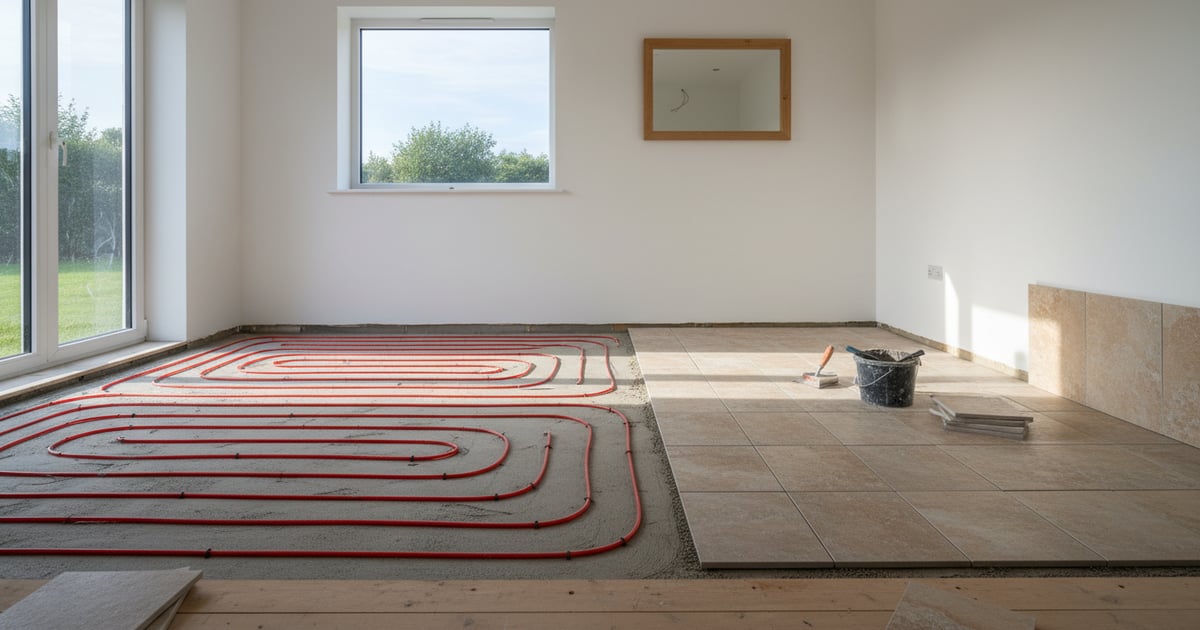
Under EVERY underfloor heating install (wet or electric), there must be insulation between the pipes and the substrate — typically 50-100mm PIR (Celotex/Kingspan) for new screed, or 6-10mm slim insulation board for retrofit. Without it, 30-50% of your heat goes DOWN into the slab instead of UP into the room. Quotes that skip this 'to save cost' double your running bills forever.
Fair UK range: £12–£25 per m² for 50-100mm PIR under-screed insulation. £8–£18 per m² for low-profile foil-faced retrofit insulation board.
Ask: What insulation type and thickness is going UNDER the pipes, and what's the U-value performance figure?
A fair quote names the actual product: Polypipe Overlay, Uponor Comfort Pipe Plus, Wavin AdvancedHeating, Robbens Hydroflex (wet); Warmup, ProWarm, ThermoSphere (electric). The brand matters because the warranty is brand-backed (typically 25-50 years on the pipe). 'Standard 16mm PEX pipe' tells you nothing — it could be £2/m generic with 5-year warranty, or £8/m premium with 50-year warranty.
Fair UK range: Wet UFH pipe: £4–£10 per linear metre supplied. Electric UFH: £20–£45 per m² for mat or cable. Manifold: £200–£500 supplied for a quality 6-zone (Polypipe, Wavin, Uponor).
Ask: Which exact pipe/cable brand and product range, and what's the manufacturer warranty in writing?
A wet UFH system needs: a manifold (where pipes branch out), a wiring centre, individual zone actuators (one per room), zone valves and controls, plus a thermostat per zone. For installs over 50m², zone control is essential — without it, the whole system runs as one zone and you can't independently control different rooms. Many cheap quotes specify a single-zone manifold for a 6-room install — that's £400 saved upfront and £8,000 of comfort/efficiency lost over 20 years.
Fair UK range: Manifold + wiring centre + actuators: £600–£1,500 for a 4-6 zone setup. Individual room thermostats: £50–£200 each (basic to smart).
Ask: How many zones is this system, and is each room independently controllable with its own thermostat and actuator?
Wet UFH pipes are typically buried in 65-75mm of liquid screed (Gyvlon/Cemfloor) or sand-cement screed. Liquid screed is faster (1-day pour, 2-3 weeks before final floor) but premium. Sand-cement is cheaper but slower (4-6 weeks curing). Retrofit installs raise the floor level by 18-30mm (low-profile) or 50-75mm (new screed) — this affects door clearances, skirting heights, threshold transitions. Often missed in initial quotes.
Fair UK range: Liquid screed: £25–£40 per m². Sand-cement screed: £18–£28 per m². Door reduction/threshold adjustments: £40–£100 per door.
Ask: What screed type (liquid or sand-cement), what depth, and have you accounted for door/threshold height adjustments?
Before screed is poured (wet) or final floor goes down (electric), the system must be: (1) pressure tested at 6 bar for at least 24 hours with documented results, (2) commissioned with flow rates set per zone, (3) heating cycle gradually ramped up over 2-3 weeks once screed has cured, (4) given a final commissioning certificate with thermostat programming. Skipping any of this is the #1 cause of leaks discovered AFTER £3,000 of tile is laid on top.
Fair UK range: Should be £0 — included in any reputable installer's quote. Standalone commissioning by a third party: £200-£400.
Ask: Will you carry out pressure testing at 6 bar for 24 hours BEFORE screed is poured, with photo evidence and a written commissioning certificate?
Want this run on your actual underfloor heating quote? Upload it and our AI Quote Checker flags missing line items, overcharges and the questions worth asking.
UK-specific signals — each red flag explains why it matters and the question that surfaces the truth.
Why it matters: Insulation under the pipes is the difference between a UFH system that costs £400/year to run and one that costs £900/year. Heat radiates in all directions — without insulation below, 30-50% goes into the slab. Quotes that skip 'to save £15/m²' cost you that money back in 2-3 years of running, then keep costing forever. This is the #1 spec error in cheap UFH quotes.
Ask: What insulation thickness and type goes UNDER the pipes, and where is it shown on the quote?
Why it matters: A reputable installer produces a CAD or hand-drawn floor plan showing pipe loops, manifold position, and circuit lengths (max 100-120m per circuit). They take photos before screed is poured. If neither is in the proposal, you have zero comeback if a leak occurs — nobody knows where the pipes run, so finding the leak means breaking up the entire floor.
Ask: Will you provide a pipe layout drawing before install, and photographic evidence of the pipework before screed is poured?
Why it matters: Pressure testing at 6 bar for 24+ hours BEFORE screed pour is the only way to verify there are no leaks. Discovering a leak AFTER screed is set means demolition of the floor — minimum £2,500-£5,000 of remedial work. Commissioning certificate documents the test results, flow rates per zone, and proves the install is sound. No certificate = no proof = no warranty enforcement.
Ask: Will you pressure test at 6 bar for 24+ hours pre-screed and provide a written commissioning certificate with results?
Why it matters: A single-zone manifold means every room runs at the same temperature — bedroom too hot, lounge too cold, no way to fix it. For installs over 50m² or covering more than one room, individual zone control (one actuator and thermostat per room) is essential. Cheap quotes save £300-£500 on zone hardware and you live with the comfort/cost penalty for 25 years.
Ask: Why is this proposed as one zone? Can you cost a multi-zone version with one thermostat per room?
Why it matters: Connecting wet UFH to a gas boiler is gas work — it requires a Gas Safe registered engineer. If your UFH installer is not Gas Safe, they need to bring one in (often costs £200-£500 in coordination). A quote that doesn't address this is either: (1) planning to do gas work illegally, or (2) about to charge you 'extras' for the Gas Safe sub-contractor.
Ask: Who's doing the boiler connection work — are they Gas Safe registered, what's their ID number, and is this cost included?
Why it matters: Electric UFH installation is notifiable under Part P of Building Regs. The installer must be NICEIC, NAPIT or STROMA registered, OR notify Building Control separately (£200-£500). They also need to issue an Electrical Installation Certificate (EIC). No registration = no Part P certificate = the install is non-compliant and a problem at house sale.
Ask: Are you NICEIC/NAPIT registered for the electrical work, and will you provide an EIC and Part P notification?
Why it matters: UFH adds 18-30mm (low-profile retrofit) to 75mm+ (new screed) to your floor height. This affects: door bottoms (need trimming or replacing), skirting heights, threshold transitions to other rooms. Quotes that skip these add 'extras' mid-job for £40-£100 per door, plus skirting reinstatement. Get it in writing upfront.
Ask: What's the total floor build-up height from existing substrate, and are door reductions, skirting and threshold work included?
Spot a couple of these on your underfloor heating quote? Upload it for a full red-flag scan and fair-rate comparison.
A simple framework, a verbatim script you can paste into an email or text, and the topic-specific levers that move the price.
I've had three quotes for a wet UFH system covering 45m² with 4 zones, Polypipe Overlay pipe, 50mm PIR insulation under the screed, Polypipe 4-port manifold and 4 zone thermostats, Gyvlon liquid screed at 65mm, full pressure testing and commissioning. Yours is competitive overall but it's £X above the median on the manifold and Y on the screed. Both other installers are also Polypipe Approved — can you match the median on those two items, or talk me through the spec difference? I'd rather use you because of [specific reason], but I need to see the maths.
Want to know which line items on your underfloor heating quote are above market before you negotiate? Upload it for a fair-rate comparison.
Vet on competence, insurance, paperwork and process — not price alone. Each question spells out the answer you want and why.
Why it matters: Manufacturer training (Polypipe Approved Installer, Uponor PRO, Wavin Sentio Specialist, Warmup Installer Network) is what underwrites the long-term pipe/cable warranty — typically 25-50 years on the pipe. Without it, you have only consumer-level warranty (often 5-10 years). Verify on the manufacturer's own 'find an installer' page, not just the installer's word.
Why it matters: UFHMA is the trade body for the UK UFH industry. Membership means: code of practice adherence, technical training, and dispute resolution. Not the only signal of quality, but absence + no manufacturer training is worth a second look.
Why it matters: Wet UFH connection to a gas boiler is gas work and legally requires Gas Safe registration. Either the installer holds it (verify at gassaferegister.co.uk) or they bring in a Gas Safe engineer (whose details you should have, with cost included). 'We'll sort it on the day' is a red flag for unauthorised gas work.
Why it matters: Electric UFH is notifiable electrical work under Part P. Installer must be NICEIC/NAPIT/STROMA registered (verify at niceic.com or napit.org.uk) and must issue an EIC plus Building Control notification. No registration = non-compliant install.
Why it matters: Documentation is what protects you when leaks happen 5-15 years later. The drawing tells the future plumber where pipes run; the photos prove the install was done correctly before being buried. No documentation = if a leak occurs, the entire floor must be lifted to find it.
Why it matters: Pressure testing pre-screed is the ONLY way to confirm leak-free pipework before it's permanently buried. The certificate is your documented evidence the install was sound on day one. Without testing, leaks discovered post-screed mean £3,000-£5,000 of demolition work.
Why it matters: UK norm is 5-10 years on workmanship for UFH (manifold leaks, joint failures, controls issues caused by them). Manufacturer warranty on the pipe itself (25-50 years) is separate. Less than 5 years on workmanship is below industry standard.
Why it matters: For installs over 50m² or multi-room, individual zone control is essential for both comfort and efficiency. A reputable installer recommends one zone per room (or per heating need); cheap quotes propose single-zone setups that hand you 25 years of poor performance.
Why it matters: UFH adds significant floor height. A reputable installer measures door bottoms, plans threshold transitions and includes door reductions in the quote. Vague answers mean £40-£100 per door of unbudgeted 'extras' mid-job.
Why it matters: VAT registration suggests genuine business turnover (£85k+ threshold). £2M public liability is the UK industry baseline — water damage from a UFH leak can easily exceed £50,000, and you need that cover behind you. Ask to see the certificate.
Already chosen a underfloor heating installer and got a quote? Run it through our Quote Checker before you commit.
Whether you're still scoping or already comparing builders, the next step is one click away.
See national cost ranges, scenarios and timelines without the regional adjustment.
Compare underfloor heating costs across the UK