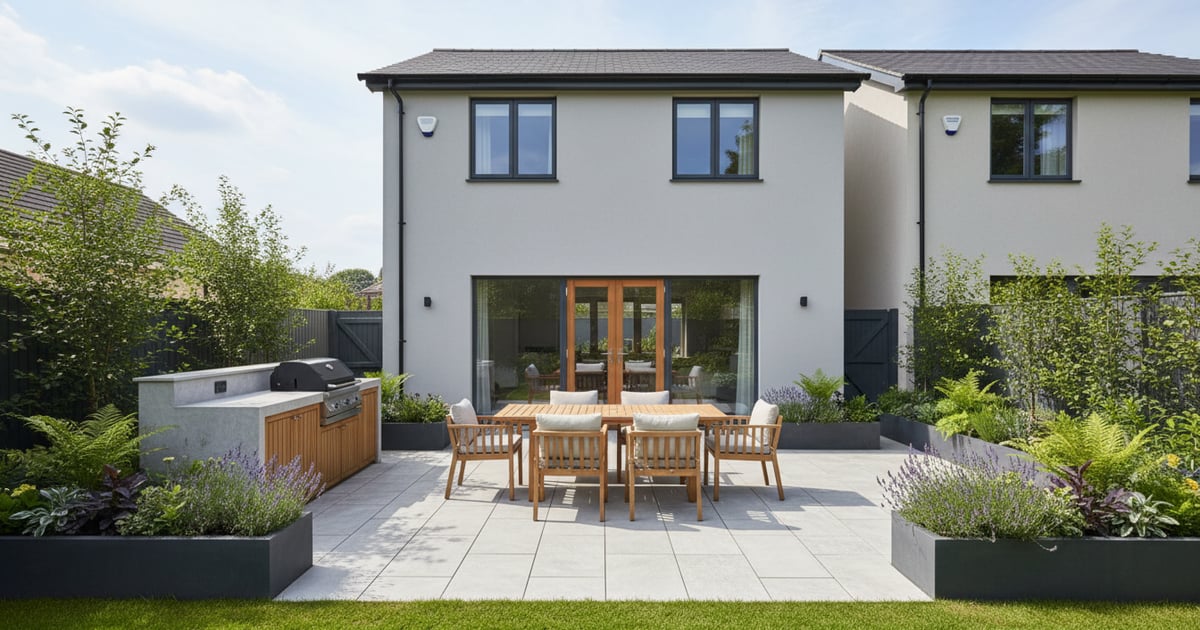
Patio Costs in Scotland

Patio Costs in Scotland

Estimates derived from UK trade benchmark data and regional labour indices, updated May 2026. Methodology →

Patio in Scotland spreads from city premiums to quieter rural jobs. Nationally we still use the same UK guide spine; this page reflects how Scottish quotes typically spread around that midpoint.

In Scotland, prices vary between cities and rural areas, but overall costs sit near the UK average. For the full UK-wide baseline, compare with Patio Cost UK.

Two ways to take action on patio costs

Pick the path that fits where you are — running early numbers, or pressure-testing a quote you've already got.

Typical Scotland patio budgets

Three planning tiers for patio in Scotland, with scope and a representative figure for each. Run your own numbers in the calculator for a tailored range.

Budget

£1,350

  • Focused essentials
  • Practical finishes
Mid-rangeMost common

£2,450

  • Balanced specification with core upgrades
  • Reliable materials
Premium

£5,100

  • Premium materials
  • Wider scope with higher coordination demands

Typical regional cost ranges

ItemCost Range
Concrete slabs (per m²)£50 – £50
Indian stone (per m²)£50 – £100
Porcelain (per m²)£50 – £100
Sub-base and prep (per m²)£0 – £50
Small patio (15 m²)£800 – £1,750

Indicative range: £50£100 per m².

Mini patio cost calculator

Three quick inputs and we'll email you an indicative range. Run the full calculator for a postcode-adjusted estimate.

Typical UK patio: 15-40m²

Unit:

Email me my estimate

We'll send the indicative range straight to your inbox.

We'll email your estimate to this address regardless. Privacy policy.

What's included in Scotland patio costs

  • Material — concrete is cheapest; porcelain and natural stone cost more.
  • Area size — larger patios spread fixed costs; small areas cost more per m².
  • Groundwork — poor ground, steps, or levels add to sub-base and labour.
  • Drainage — fall and channel drains may be needed.
  • Edging and steps — brick or stone edging and steps add cost.
  • Location — London and the South East typically cost 15–25% more.

5 line items every fair patio quote should include

Use this checklist to spot missing scope before you sign — each item names what should be priced and what to ask for if it isn't.

  1. 1

    Sub-base preparation + excavation

    A patio needs proper foundations: 100mm Type 1 MOT compacted aggregate, plus a 30-40mm screed bed for laying the slabs. Existing topsoil or clay must be dug out (typically 200-250mm total depth excavated). Without proper sub-base, the patio cracks and settles within 2-3 years.

    Fair UK range: £20-£40/m² for sub-base + excavation depending on existing conditions.

    Ask: What sub-base depth (150mm minimum), and is excavation/disposal itemised separately?

  2. 2

    Falls (drainage gradient) — typically 1:80 away from house

    Patios MUST shed water away from the house — typically a 1:80 fall (1cm per 80cm) toward the garden. Without proper falls, water pools against the house wall and causes damp. This is an installation skill that cheap installers skip.

    Fair UK range: Fall design is included in proper installation; should be itemised on plans.

    Ask: What's the fall plan (gradient and direction)? Patio must shed water away from the house at 1:80 minimum.

  3. 3

    Patio material — manufacturer, range, thickness

    A fair quote names the material (Bradstone, Marshalls Indian sandstone, Stonemarket porcelain, etc.), the range, and thickness (20mm porcelain, 22-30mm natural stone). Generic 'sandstone slabs' could be £20/m² Indian import or £50/m² Marshalls — different lifespan and quality.

    Fair UK range: Material costs vary: concrete slab £15-£30/m²; Indian sandstone £25-£50/m²; porcelain £35-£70/m²; granite £50-£100/m²+.

    Ask: Which manufacturer and range, what thickness? Can I see the product brochure?

  4. 4

    Edge detail + jointing compound

    Edges need restraining (concrete haunching or proper edge stones). Joints filled with mortar (traditional) or polymeric jointing compound (modern, weed-resistant, longer-lasting). Cheap installs use weak mortar that washes out within 2 seasons.

    Fair UK range: £8-£15/m² for proper jointing; polymeric adds £4-£8/m² over basic mortar.

    Ask: How are edges restrained, and what jointing compound are you using?

  5. 5

    Drainage to garden / soakaway (if non-permeable)

    Patios attached to the house may need drainage channels (linear drains) at the house wall to catch run-off. If SUDS issues apply (front garden, large area), a soakaway may be needed. Cheap quotes ignore drainage and you get rotten skirting in 18 months.

    Fair UK range: £200-£800 for linear drain at house wall; £400-£1,500 for soakaway.

    Ask: Is drainage at the house wall included, and is there any SUDS provision needed?

Want this run on your actual patio quote? Upload it and our AI Quote Checker flags missing line items, overcharges and the questions worth asking.

Check my quote

7 red flags that mean you might be overcharged on a patio quote

UK-specific signals — each red flag explains why it matters and the question that surfaces the truth.

  • No falls/drainage gradient mentioned

    Why it matters: Patios MUST shed water away from the house (typically 1:80 minimum gradient). Without proper falls, water pools at the house wall, causing damp and rotting skirting boards. Cheap installers lay flat patios because it's easier — and cheaper for them, costlier for you long-term.

    Ask: What's the falls/drainage plan? Patio must shed water away from the house at 1:80 minimum.

  • Sub-base less than 100mm Type 1 MOT

    Why it matters: Inadequate sub-base causes patio settlement and cracking within 2-3 years. UK patio standard is 100-150mm Type 1 MOT compacted, plus 30-40mm screed bed. Cheap installs use sand only or skip the sub-base entirely.

    Ask: What sub-base depth and material are you using? 100mm Type 1 MOT minimum is industry standard.

  • Material brand and thickness not specified

    Why it matters: Patio quality varies wildly with material spec. £20/m² Indian sandstone vs £45/m² Marshalls Indian sandstone — same look initially, very different lifespans. Without spec, you can't compare quotes.

    Ask: Which manufacturer and product range? Marshalls, Bradstone, Stonemarket are real spec — can I see the brochure?

  • No edge restraint mentioned

    Why it matters: Without concrete haunching or proper edge stones, patio edges spread sideways under foot traffic and lawn pressure. Fails in 3-5 years. Reputable landscapers always include edge treatment.

    Ask: How are patio edges restrained? Concrete haunching is industry standard.

  • No mention of expansion joints on large patios (>30m²)

    Why it matters: Large patios need expansion joints every 3-5m to allow for thermal movement. Without them, slabs crack as they expand and contract through seasons. Cheap installs skip this and you get cracks within 2-3 years.

    Ask: On a patio this size, where are the expansion joints designed?

  • Quote significantly below £80/m² for natural stone or porcelain

    Why it matters: UK 2026 typical for natural stone/porcelain installed is £100-£180/m². Below £80/m² usually means: cheap imported material, no proper sub-base, no falls design, no edge restraint, weak mortar joints. Patio fails in 3-5 years.

    Ask: How are you achieving this price? What sub-base, falls design, material brand, and edge restraint is included?

  • Door-knockers offering 'leftover material'

    Why it matters: Same as driveway scammers — door-knocking landscapers offering 'leftover stone from a job up the road' are invariably cowboys. Patio fails within 2 years; installer is untraceable. Walk away.

    Ask: Can I take a week to compare quotes? Door-knockers don't get my business.

Spot a couple of these on your patio quote? Upload it for a full red-flag scan and fair-rate comparison.

Check my quote

How to negotiate a patio quote

A simple framework, a verbatim script you can paste into an email or text, and the topic-specific levers that move the price.

Framework

  1. 1Get three quotes specifying the same scope: same area in m², same material (named brand/range/thickness), same sub-base depth, same falls design, same edge treatment. Door-knockers don't get to quote — only respond to landscapers you've sourced (BALI, APL, Checkatrade, local recommendation).
  2. 2Demand itemised breakdowns: excavation, sub-base, falls + drainage, material, edge restraint, jointing, expansion joints (if applicable). Reject single-total quotes.
  3. 3Identify the median per major line. The total spread on patios is usually 30-60% — much of it is sub-base shortcuts and material substitution. The sub-base + material spread is your reliability filter.
  4. 4Approach your preferred installer (chase BALI/APL membership + recent local references over lowest price). Ask them to match the median on individual lines. Confirm falls design and warranty in writing.

Verbatim script

I've had three quotes for this patio. Yours is competitive overall, but the sub-base line is £X above the median I've received from two other BALI-registered landscapers, and the material line is £Y above. The other quotes specify [Marshalls/Bradstone] [range] at 22mm thickness with proper falls design. Can you walk me through your sub-base and material pricing, and confirm falls design and edge restraint are itemised?

Topic-specific levers

  • Material brand: Marshalls Indian sandstone (£35-£50/m² material) is industry standard quality; cheaper imports save 30% but quality + warranty suffer.
  • Porcelain vs natural stone: porcelain (£35-£70/m²) is more durable, fade-resistant, and easier to clean than natural stone (£25-£50/m²). Worth the upgrade for high-traffic patios.
  • DIY excavation: hire a digger and skip yourself, save £400-£1,200 on excavation. Installer quotes for surface only.
  • Bundle with driveway: if doing both at the same time, single mobilisation saves 15-25% vs separate jobs.
  • Off-season scheduling: patio installers are quiet October-March (weather-dependent). Booking then often saves 10-15%.

Want to know which line items on your patio quote are above market before you negotiate? Upload it for a fair-rate comparison.

Check my quote

10 questions to ask before hiring a patio installer / landscaper

Vet on competence, insurance, paperwork and process — not price alone. Each question spells out the answer you want and why.

  1. 1. Are you a member of BALI (British Association of Landscape Industries) or APL (Association of Professional Landscapers)?

    Why it matters: BALI and APL members are vetted on competence and adherence to industry standards. Verifiable on each association's public register.

  2. 2. Are you Marshalls or Bradstone Approved Installer for branded products?

    Why it matters: Approved Installer status means manufacturer training and warranty access (typically 10-year). Without it, manufacturer warranty doesn't apply.

  3. 3. Can you show me 2-3 recent local patio installations (last 12 months) with homeowner contact details?

    Why it matters: Patio issues (settlement, cracking, weed growth, drainage problems) appear at 12-24 months. Local references let you visit patios and ask homeowners about post-install experience.

  4. 4. What sub-base depth and material are you using, and how do you compact it?

    Why it matters: Sub-base spec drives patio longevity. Reputable installers use 100mm+ Type 1 MOT compacted in layers, plus 30-40mm screed bed.

  5. 5. What's the falls/drainage plan?

    Why it matters: Patios must shed water away from the house. Reputable installers can describe gradient (1:80 minimum) and drainage destination explicitly.

  6. 6. What edge restraints and jointing material are you using?

    Why it matters: Edge restraint (concrete haunching) prevents spread; quality jointing (polymeric or strong mortar) prevents weed growth and washout. Cheap installs skip both.

  7. 7. What's your installation warranty in writing?

    Why it matters: Industry norm: 10-year manufacturer warranty (if Approved Installer) + 12-24 months installer workmanship. Verbal-only is sub-standard.

  8. 8. What's your payment schedule?

    Why it matters: Industry norm: 10-25% deposit, balance on satisfactory completion. Patio scammers often demand large upfront cash payments.

  9. 9. Are you VAT registered, and will you provide a proper invoice?

    Why it matters: Cash-only or no-invoice arrangements forfeit consumer protection. Patio work without invoice is a scam indicator.

  10. 10. Do you carry public liability insurance, and at what level?

    Why it matters: Patio work involves machinery and damage risk to existing property. £2M minimum public liability is industry norm.

Already chosen a patio installer / landscaper and got a quote? Run it through our Quote Checker before you commit.

Check my quote

Ready to act on your patio project?

Whether you're still scoping or already comparing builders, the next step is one click away.

Compare other regions

Other renovation costs in Scotland

All Scotland renovation costs

Frequently asked questions

Want the UK-wide picture for patio?

See national cost ranges, scenarios and timelines without the regional adjustment.

Compare patio costs across the UK