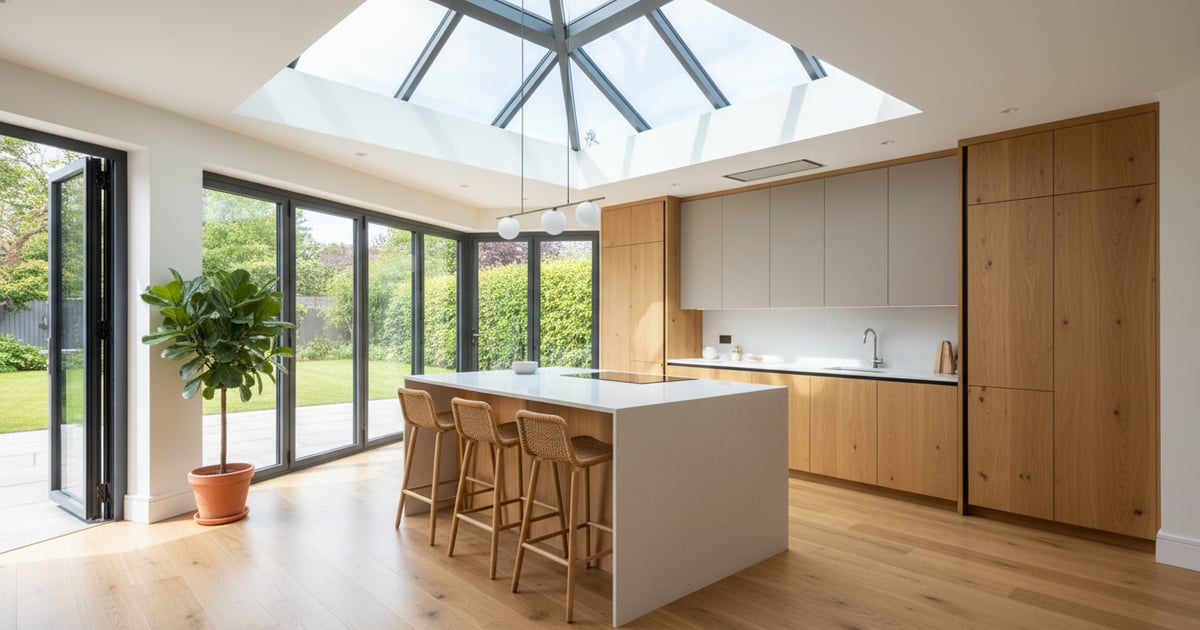
Kitchen Extension Costs in West Midlands

Kitchen Extension Costs in West Midlands

Estimates derived from UK trade benchmark data and regional labour indices, updated May 2026. Methodology →

Kitchen Extension in West Midlands usually hews close to the UK average — a useful baseline if you want “typical” without London premiums. Our national guide ranges are the spine; this page is the regional read.

In West Midlands, costs are usually close to the UK average. For the full UK-wide baseline, compare with Kitchen Extension Cost UK.

Two ways to take action on kitchen extension costs

Pick the path that fits where you are — running early numbers, or pressure-testing a quote you've already got.

Typical West Midlands kitchen extension budgets

Three planning tiers for kitchen extension in West Midlands, with scope and a representative figure for each. Run your own numbers in the calculator for a tailored range.

Budget

£42,500

  • Focused essentials
  • Practical finishes
Mid-rangeMost common

£65,000

  • Balanced specification with core upgrades
  • Reliable materials
Premium

£102,000

  • Premium materials
  • Wider scope with higher coordination demands

Typical regional cost ranges

ItemCost Range
Single-storey extension shell (15 m²)£22,000 – £45,000
Kitchen fit-out (mid-range)£8,000 – £20,000
Kitchen fit-out (premium)£20,000 – £50,000
Bifold or sliding doors (3–4 m)£3,500 – £9,000
Full kitchen extension (build + mid kitchen)£35,000 – £65,000

Indicative range: £1,500£3,500 per m².

Mini kitchen extension cost calculator

Three quick inputs and we'll email you an indicative range. Run the full calculator for a postcode-adjusted estimate.

New floor area added (typically 4-6m wide × 4m deep)

Unit:

Email me my estimate

We'll send the indicative range straight to your inbox.

We'll email your estimate to this address regardless. Privacy policy.

What's included in West Midlands kitchen extension costs

  • Extension size — larger footprint costs more in build; kitchen fit-out scales with size and spec.
  • Build spec — standard vs high-spec finishes, glazing, and roofing.
  • Kitchen specification — flat-pack to bespoke; worktops and appliances are a big variable.
  • Bifolds and glazing — large openings add significant cost.
  • Services — moving or adding plumbing, gas, and electrics.
  • Location — London and the South East typically cost 20–40% more.

5 line items every fair kitchen extension quote should include

Use this checklist to spot missing scope before you sign — each item names what should be priced and what to ask for if it isn't.

  1. 1

    Architect drawings + structural engineer fees

    A kitchen extension involves load-bearing walls (almost always — the existing back wall comes out), so structural calculations are mandatory. Architect drawings are needed for planning (if applicable) and Building Control. These are typically separate from the build quote.

    Fair UK range: £2,000–£5,000 architect; £800–£2,500 structural engineer.

    Ask: Are architect and structural engineer fees included separately in this quote, or arranged by me?

  2. 2

    Foundations + structural shell (build to roof)

    This is the 'getting weather-tight' phase: digging foundations, building walls (cavity construction with insulation), installing the roof structure, fitting windows and doors. The biggest single cost block on the project.

    Fair UK range: £1,400–£2,000/m² for shell construction depending on spec.

    Ask: Can you break down the shell cost into foundations, walls, roof, and windows/doors as separate sub-totals?

  3. 3

    Kitchen fit-out — units, worktops, appliances, installation

    Kitchen unit cost varies massively (£6k Howdens to £40k+ bespoke). A fair quote separates: carcase/unit cost, worktop, appliances, taps/sink, kitchen fitter labour. Don't let the contractor bundle all this into 'kitchen fit'.

    Fair UK range: £8,000–£40,000+ for the kitchen itself depending on spec; £1,500–£3,500 for kitchen fitter labour.

    Ask: Can you itemise: units, worktops, appliances, taps/sinks, fitter labour as separate lines?

  4. 4

    First fix + second fix services (electrics, plumbing, heating)

    Electrical (sockets, lighting, cooker circuit, extractor — all Part P certified by NICEIC electrician), plumbing (sink, dishwasher, hot/cold feeds), heating (radiators or underfloor heating connection). These need to be itemised — bundled 'services' line is a red flag.

    Fair UK range: £3,500–£7,000 for combined first/second fix services on a typical kitchen extension.

    Ask: Are electrics and plumbing itemised separately, with Part P certification by an NICEIC/NAPIT electrician?

  5. 5

    Floor finish, decoration, snagging

    The 'final 5%' that often gets squeezed: floor finishing (tile, LVT, polished concrete), painting, skirting, sealing, snagging. Cheap quotes underbid this and you end up either paying extras or moving in to an unfinished kitchen.

    Fair UK range: £3,000–£8,000 depending on floor finish and decoration scope.

    Ask: What flooring spec is included, and is decoration of the new space and reinstatement of any disrupted areas covered?

Want this run on your actual kitchen extension quote? Upload it and our AI Quote Checker flags missing line items, overcharges and the questions worth asking.

Check my quote

7 red flags that mean you might be overcharged on a kitchen extension quote

UK-specific signals — each red flag explains why it matters and the question that surfaces the truth.

  • Single-trader quote with no separate kitchen fitter or electrician

    Why it matters: A kitchen extension involves at least 6 distinct trades: structural builder, electrician (Part P certified), plumber, kitchen fitter, tiler, decorator. A single trader doing all of these is either inexperienced or cutting corners on certification.

    Ask: Who specifically does the electrical work and is it Part P notifiable? Who fits the kitchen units?

  • No JCT contract or written variation procedure

    Why it matters: On a £40k–£80k project, working without a JCT Minor Works contract or equivalent is reckless. There's no defined payment schedule, variation procedure, or dispute mechanism — just vibes.

    Ask: Will you work to a JCT Minor Works contract, and how are variations handled — written orders, prior approval?

  • Underfloor heating not decided pre-screed

    Why it matters: Underfloor heating (UFH) is laid before the floor screed. If you decide to add UFH AFTER the screed, you're either ripping it up (£3–5k extra) or living without it. A reputable contractor confirms UFH decision in the design phase.

    Ask: Is underfloor heating included or decided? It must be agreed BEFORE the screed goes down.

  • No FENSA/CERTASS registration for new windows or bi-fold doors

    Why it matters: All replacement and new windows/doors must be installed by FENSA or CERTASS-registered installers (Building Regs Part L). Without that registration, you can't get the compliance certificate — a major issue on resale.

    Ask: Are the windows and bi-fold doors being installed by a FENSA or CERTASS-registered installer, with compliance certificate provided?

  • Vague 'fit-out' line covering electrics + plumbing + kitchen

    Why it matters: Bundling electrics, plumbing, and kitchen fit into one 'fit-out' line hides where the money is. It's also where contractors substitute lower-spec work without telling you.

    Ask: Can you separate electrics, plumbing, and kitchen fit-out into distinct line items with sub-totals?

  • No Party Wall Award mentioned for terraced or semi-detached

    Why it matters: Kitchen extensions on attached homes almost always trigger the Party Wall Act 1996. Awards take 4–8 weeks and cost £700–£1,500. A contractor who doesn't mention it is hoping you won't notice — until your neighbour serves notice mid-build.

    Ask: Will this trigger the Party Wall Act, and have you allowed for surveyor fees and timing?

  • Payment schedule with more than 20% upfront on a £50k+ project

    Why it matters: On a long project (8–14 weeks), upfront payments fund the contractor's other work. If they go bust mid-build, you're an unsecured creditor. Industry norm: stage payments tied to verifiable milestones (foundations, weathertight, first fix complete, completion).

    Ask: Can we agree stage payments tied to milestones, with no more than 20% upfront and verifiable inspection at each stage?

Spot a couple of these on your kitchen extension quote? Upload it for a full red-flag scan and fair-rate comparison.

Check my quote

How to negotiate a kitchen extension quote

A simple framework, a verbatim script you can paste into an email or text, and the topic-specific levers that move the price.

Framework

  1. 1Get three quotes from FMB-registered or TrustMark-accredited contractors for an identical scope: same area, same kitchen spec range (mid Howdens / mid bespoke / premium), same glazing scope, same flooring. Without identical scope, you're comparing apples to oranges on a £50k+ decision.
  2. 2Demand itemised breakdowns covering: design fees, foundations, shell, windows/doors, electrics, plumbing, kitchen units, kitchen fitter, worktops, appliances, flooring, decoration. Reject single-total or 'all-inclusive' quotes — too easy to hide thin work.
  3. 3Identify the median per major line. The total spread on kitchen extensions is often £20–40k across three quotes — meaningless. The line-item spread shows you who's lowballing the kitchen spec or padding the build.
  4. 4Insist on a JCT Minor Works contract. This caps payment terms, defines variations, and gives legal recourse on a six-figure project. Reputable contractors welcome it; cowboys don't.

Verbatim script

I've had three quotes for this kitchen extension. Yours is competitive overall, but the shell construction is £X above the median I've received from two other FMB-registered contractors, and the kitchen fit-out line is £Y below. The other quotes specify [brand/spec] units and [bi-fold brand]. Can you walk me through what's included in your shell pricing, and confirm the kitchen spec includes the same components, and let me know if you'll work to a JCT Minor Works contract?

Topic-specific levers

  • Project management split: contractor-managed costs 12–18% PM markup. If you're confident, hire trades separately (builder, kitchen fitter, electrician, plumber) and self-manage — typically saves 10–15% but requires significant time.
  • Kitchen sourcing: separate kitchen-only quotes from Howdens, Wren, IKEA Bespoke, and bespoke makers. Compare against the contractor's kitchen line — sometimes you can shave £3–8k by sourcing the kitchen yourself.
  • Bi-fold/sliding door brand: Aluminium bi-folds range from £400/m (Origin entry) to £2,000/m (Schueco). Decide spec early — the price difference is huge.
  • Roof lantern vs flat roof + skylights: lanterns are £4,000–£8,000 each; equivalent skylights are £1,500–£3,000. Decide what natural light matters.
  • Phase the kitchen later: have the builder finish the shell, then do the kitchen 1–3 months later when you've had time to spec properly and shop around. Often saves 10–20% vs contractor-supplied kitchen.

Want to know which line items on your kitchen extension quote are above market before you negotiate? Upload it for a fair-rate comparison.

Check my quote

10 questions to ask before hiring a kitchen extension contractor

Vet on competence, insurance, paperwork and process — not price alone. Each question spells out the answer you want and why.

  1. 1. Are you a member of the FMB (Federation of Master Builders), TrustMark, or NHBC?

    Why it matters: FMB and TrustMark members are vetted on workmanship and finances. They typically offer Insurance-Backed Warranties (IBG). NHBC is for new-build work but signals seriousness.

  2. 2. Can you show me 2–3 completed kitchen extensions in this region from the last 12 months, with homeowner contact details?

    Why it matters: Recent local references let you visit the actual work and speak to past clients about the experience — particularly variations, communication, and snagging.

  3. 3. Who's the structural engineer, are they IStructE-registered, and do you have established working relationship?

    Why it matters: Structural design is critical and regulated. The engineer should be IStructE-registered with current PI insurance. Vague 'we'll get one' usually means they don't have an established relationship.

  4. 4. What contract are you proposing — JCT Minor Works, JCT Home Owner, or your own terms?

    Why it matters: JCT contracts are industry standard and define payment, variations, and dispute resolution. Contractors offering only 'their own terms' usually have less protection for you.

  5. 5. What's your payment schedule, and what milestones trigger each stage?

    Why it matters: Stage payments tied to verifiable milestones (foundations laid, weather-tight, first fix complete, etc.) protect you if the contractor goes bust. Calendar-based payments don't.

  6. 6. Will you handle the Building Regs application (Full Plans) and arrange Building Control inspections?

    Why it matters: Full Plans is preferable to Building Notice for extensions (you get written approval before work). Some contractors prefer Building Notice (less paperwork, more risk for you).

  7. 7. Who fits the kitchen units, and is that trade FENSA/CERTASS for the windows and doors?

    Why it matters: Kitchen fitting is a separate trade (often 'KBSA member'). Window/door installation requires FENSA or CERTASS for Part L compliance. A single trader claiming to do all of this raises red flags.

  8. 8. How will you protect the existing house from dust and weather during construction?

    Why it matters: Knocking out the back wall creates an open hole. Reputable contractors use temporary weatherproof partitions and dust screens. Vague answers mean ruined carpets and wet rooms.

  9. 9. What's the warranty on the workmanship, and is it insurance-backed?

    Why it matters: Industry norm: 10-year insurance-backed warranty (FMB IBG, BuildSure, etc.) for structural; 12–24 months for other workmanship. Verbal-only warranties are worthless if the contractor goes bust.

  10. 10. Are you VAT registered, and what's your public liability cover?

    Why it matters: VAT registration matters for invoicing and warranty enforcement. Public liability of £5M minimum is industry norm for £40k+ projects. Ask to see certificates.

Already chosen a kitchen extension contractor and got a quote? Run it through our Quote Checker before you commit.

Check my quote

Ready to act on your kitchen extension project?

Whether you're still scoping or already comparing builders, the next step is one click away.

Compare other regions

Other renovation costs in West Midlands

All West Midlands renovation costs

Frequently asked questions

Want the UK-wide picture for kitchen extension?

See national cost ranges, scenarios and timelines without the regional adjustment.

Compare kitchen extension costs across the UK