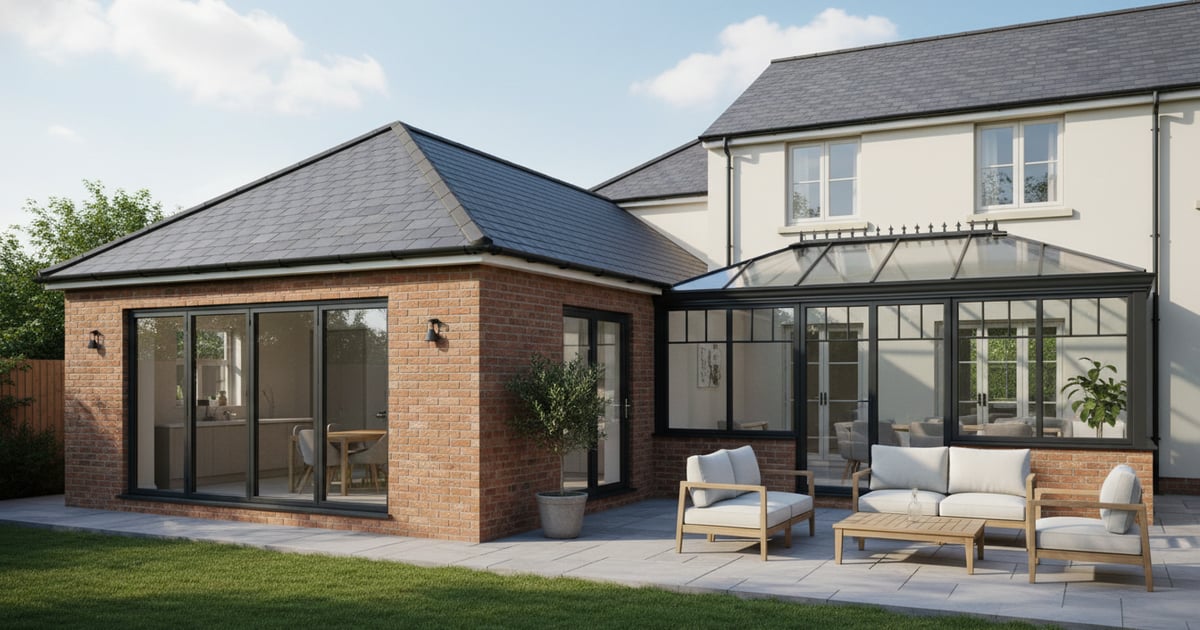
Extension vs Conservatory Cost UK
Decide extension vs conservatory in 60 seconds — and avoid the £30k 'conservatory I can't use in winter' mistake.
Estimates based on UK trade benchmark data, updated 2 May 2026. Methodology →
Extensions and conservatories can both add space, but they deliver very different comfort levels and long-term value. This guide compares extension vs conservatory costs in the UK in 2026, including realistic budget bands, usability trade-offs, and where each option makes the most sense.
Most projects fall between £28,560 and £38,640. Budget refreshes start near £9,120; premium projects reach up to £81,900.
Two ways to take action on Extension vs Conservatory costs
Pick the path that fits where you are — running early numbers, or pressure-testing a quote you've already got.
Typical UK Cost by Scenario
Typical timeline: 2 to 14 weeksBudget
£18,000
typical figure
- Focused essentials
- Practical finishes
Mid-range
Most common£33,600
typical figure
- Balanced specification with core upgrades
- Reliable materials
Premium
£61,110
typical figure
- Premium materials
- Wider scope with higher coordination demands
Figures are typical UK averages including labour, materials, and VAT at 20% for standard-rated work.
Save money on your quote
Already got a quote from a builder?
Upload it and our AI Quote Checker flags overcharges, missing scope, and the questions worth asking — in about a minute.
Typical UK Cost Ranges for Extension vs Conservatory
| Item | Cost Range |
|---|---|
| Conservatory (lean-to, small) | £9,600 – £18,000 |
| Conservatory (medium) | £14,400 – £26,400 |
| Orangery / solid roof conservatory | £24,000 – £54,000 |
| Single-storey extension (15 m²) | £26,400 – £54,000 |
| Single-storey extension (25 m²) | £42,000 – £78,000 |
| Year-round comfort | £0 – £0 |
All prices are approximate UK averages including labour, materials, and VAT at 20% (2026). Some qualifying renovations for empty homes may use the reduced 5% VAT rate.
Mini Extension vs Conservatory cost calculator
Three quick inputs and we'll email you an indicative range. Run the full calculator for a postcode-adjusted estimate.
Real UK Cost Examples
- Budget scenario (3-bed terrace, Cardiff): focused essentials and practical finishes. Not done: major layout or structural changes. Approx cost: £7,600 to £22,400.
- Mid-range scenario (typical homeowner, 4-bed detached): balanced specification with core upgrades and reliable materials. Approx cost: £23,800 to £32,200.
- High-end scenario (bungalow): premium materials and wider scope with higher coordination demands. Main cost drivers: specification level and complexity. Approx cost: £33,600 to £68,250.
Related next steps:
What You Can Get For Your Budget
- Around £19,600: core refresh and essential upgrades, usually with no major layout change.
- Around £28,000: balanced refit scope with better materials and targeted performance improvements.
- £42,000+: wider flexibility on finish quality, scope depth, and more complex works.
Hidden Costs to Watch For
- Groundworks and thermal-spec upgrades can push costs beyond entry-level assumptions.
- Waste removal, making-good, and repeat trade visits are common late-budget increases.
- Compliance and certification items are often missing from initial summary quotes.
- In most UK projects, scope changes after works start are where costs escalate fastest.
Related next steps:
Should You Do This Renovation?
- Usually worth it when extension vs conservatory solves a clear usability, compliance, or energy-performance problem.
- Less worth it when the main issue is cosmetic and resale timing is short-term.
- ROI is strongest when scope is disciplined and specification matches local value levels.
Common Cost Mistakes
- Underestimating labour and preliminaries while focusing only on material prices.
- Changing scope mid-project without budget re-baselining.
- Choosing the cheapest quote without checking detailed inclusions and exclusions.
- Running too little contingency for hidden defects and compliance upgrades.
Key Cost Factors
- Conservatory — cheaper per m²; often permitted development; can be cold in winter and hot in summer unless upgraded; uPVC or aluminium frame.
- Extension — full insulation, heating, and building regs; usable year-round; higher cost; may need planning for larger sizes.
- Orangery / solid roof — bridges the gap; more comfortable than all-glass conservatory but usually cheaper than full extension.
- Planning — conservatories often permitted dev; extensions beyond certain size need planning.
- Use — if you want a proper room (e.g. kitchen-diner), extension is the right choice; if you want a sunroom or occasional space, conservatory can suffice.
- Location — both cost 15–25% more in London and the South East.
Cost Checkpoints
Use these checkpoints to sequence spend decisions, protect your core scope, and reduce late-stage budget overruns.
- Prioritise single-storey extension (25 m²) first: typical range £42k to £78k can shift the whole project budget if scope changes late.
- Prioritise orangery / solid roof conservatory next: typical range £24k to £54k can shift the whole project budget if scope changes late.
- Use £28k as a working midpoint and hold a contingency of roughly 10% to 15% for unknowns and making-good works.
- Request like-for-like quotes with labour, materials, and exclusions split out so you can compare options without hidden scope gaps.
5 line items every fair Extension vs Conservatory quote should include
Use this checklist to spot missing scope before you sign — each item names what should be priced and what to ask for if it isn't.
- 1
Cost comparison — conservatory vs extension per m²
Conservatory: £800-£1,500/m² (basic poly roof to glass); £1,500-£2,200/m² (solid/tiled roof). Extension: £2,400-£3,500/m² (single-storey, full Building Regs, year-round usable). Extension is typically 2-3x more expensive per m² for similar floor area — but produces a fundamentally different result.
Fair UK range: Conservatory £8k-£25k typical; Extension £30k-£60k for similar floor area.
Ask: What's the per-m² rate, and what's the year-round usability of each option?
- 2
Year-round usability — the deciding factor
Polycarbonate-roof conservatories: unusable in summer (overheats to 40°C+) and winter (cold, condensation). Glass-roof conservatories: better but still 5-10°C colder than house in winter. Solid/tiled conservatory: usable year-round but starts approaching extension cost. Extension: full Building Regs Part L = year-round comfortable.
Fair UK range: Polycarbonate conservatory: usable ~6 months/year. Extension: usable 12 months/year (true habitable space).
Ask: Will I genuinely use this space in January? Polycarbonate conservatories rarely deliver on year-round use claims.
- 3
Building Regs treatment
Conservatories EXEMPT from Building Regs IF: floor area ≤30m², separated from house by external-quality door, no fixed heating system independent of house. If you want heating or solid roof, Building Regs apply (typically £400-£800). Extensions ALWAYS need Building Regs — that's why they're properly habitable.
Fair UK range: Conservatory: Building Regs exempt if rules followed. Extension: full Building Regs always (£400-£1,200).
Ask: Will the conservatory keep the dividing door for Building Regs exemption, or do I want true integration (which triggers Part L)?
- 4
Resale value uplift comparison
Polycarbonate conservatory: often £0 value uplift, sometimes -£5k (buyers see it as repair liability). Glass conservatory: £3k-£10k uplift typical. Solid-roof conservatory: £15k-£30k uplift (functions as extra room). Extension: £30k-£60k uplift typical, often best ROI of any UK home improvement.
Fair UK range: Conservatory ROI: poor to negative. Solid-roof conservatory: 50-80% ROI. Extension: 60-100% ROI.
Ask: Get 2-3 estate agent valuations comparing post-build value under each scenario. Conservatory ROI is often disappointing.
- 5
Planning permission likelihood
Conservatories: usually permitted development (no planning needed) if rear, single-storey, within size limits. Extensions: often need planning if over 3m/4m rear extension limits. Conservation areas restrict both.
Fair UK range: Conservatory: 90% permitted development. Extension: 50% permitted development depending on size.
Ask: Does each option fall within Permitted Development limits, or does either need full planning?
Want this run on your actual Extension vs Conservatory quote? Upload it and our AI Quote Checker flags missing line items, overcharges and the questions worth asking.
7 red flags that mean you might be overcharged on a Extension vs Conservatory quote
UK-specific signals — each red flag explains why it matters and the question that surfaces the truth.
Conservatory salesperson promising 'year-round use' with polycarbonate roof
Why it matters: Polycarbonate roofs make conservatories unusable in summer (overheating) and winter (cold + condensation). Anyone promising 'year-round use' with polycarbonate is misleading you. For year-round use, you need solid/tiled roof — which approaches extension cost.
Ask: If I want year-round use, what roof type and heating do you recommend? Polycarbonate isn't suitable.
High-pressure sales tactics from national chain conservatory firms
Why it matters: Anglian, Everest, Britelite, SafeStyle have all faced regulatory action over inflated initial prices and 'today only' discounts. Their actual product is usually fine but you'll pay 50-100% more than equivalent local installer rates.
Ask: Can I take 2 weeks to compare quotes? National chain salespeople punish you for taking time — that's the answer.
Extension quote without considering conservatory alternative
Why it matters: If your goal is occasional/seasonal use of garden space, an extension is over-engineered (and 2-3x more expensive). A contractor who doesn't even discuss conservatory option for that use case is biased.
Ask: Could the same use case be met by a quality conservatory at lower cost?
Conservatory quote that removes dividing door without Building Regs
Why it matters: Removing the dividing door between house and conservatory makes it part of the heated house — triggers Building Regs Part L. Most polycarbonate/glass conservatories fail Part L. Removing the door without compliance work is illegal.
Ask: Will the dividing door stay (for Building Regs exemption), or are you doing the Part L work to make this part of the heated house?
Conservatory quote without DGCOS or HIES membership
Why it matters: DGCOS (Double Glazing & Conservatory Ombudsman Scheme) and HIES provide insurance-backed guarantees. Conservatory installers fail at higher-than-average rates. Without IBG, the warranty dies with the installer.
Ask: Are you a member of DGCOS or HIES? Is the warranty insurance-backed?
Extension quote significantly below £2,000/m² (outside London)
Why it matters: UK 2026 typical for single-storey extension is £2,400-£3,500/m². Below £2,000/m² usually means: missing professional fees, Party Wall Awards, structural engineer, Part L insulation, or quality finishes.
Ask: How are you achieving this extension price? What's included for structural fees, Party Wall, and finishes?
Both quotes ignore long-term running cost
Why it matters: Polycarbonate conservatory used as 'occasional' room: minimal running cost. Glass conservatory used year-round (with electric heaters): £400-£800/year electricity. Extension to Part L: £100-£200/year heating. Over 10 years, the running cost gap can be £4-£8k — partially offsetting build cost difference.
Ask: What's the realistic annual running cost for each option, and how does it shift the lifetime cost comparison?
Spot a couple of these on your Extension vs Conservatory quote? Upload it for a full red-flag scan and fair-rate comparison.
How to negotiate a Extension vs Conservatory quote
A simple framework, a verbatim script you can paste into an email or text, and the topic-specific levers that move the price.
Framework
- 1Be honest about intended use FIRST. If you want occasional/seasonal garden room, conservatory is fine. If you want year-round habitable space, extension is the right answer despite higher cost.
- 2Get THREE quotes — for whichever direction you commit to. For conservatory, AVOID national chains (Anglian/Everest/Britelite) on first compare; get local DGCOS-registered installer quotes first.
- 3Demand both options costed if you're genuinely undecided. Reputable contractors who do both will give honest comparison; salespeople for one type won't.
- 4Get 2-3 estate agent valuations. Conservatory ROI is often poor to negative; extension ROI is often best of any improvement. The market verdict often makes the decision clearer than functional considerations.
Verbatim script
I'm comparing a conservatory to a single-storey extension. My intended use is [year-round habitable / summer-only garden room]. Could you quote for the [conservatory option / extension option] honestly, and tell me what scope I'd need from the alternative type for a like-for-like comparison? I want to compare: build cost, year-round usability, running cost, value uplift, and disruption.
Topic-specific levers
- Use-driven decision: occasional/summer use = conservatory (cost-effective for the use case). Year-round habitable = extension (don't try to make a conservatory work year-round; it won't).
- Roof upgrade: solid/tiled conservatory roof costs £3-£8k more than polycarbonate but transforms year-round usability — and if going solid, you might as well build a proper extension for not much more.
- Local installer for conservatory: avoid Anglian/Everest/Britelite for first quotes (often 50-100% above local installer rates for same product). Get a local DGCOS-registered installer quote first.
- Planning route: conservatory usually permitted development; extension often needs planning. If timing matters, conservatory delivers in 8-12 weeks vs extension's 20+ weeks.
- Long-term ROI: extension typically adds £30-£60k value (60-100% ROI on cost). Conservatory adds £0-£15k (0-50% ROI). For investment-driven thinking, extension wins despite higher cost.
Want to know which line items on your Extension vs Conservatory quote are above market before you negotiate? Upload it for a fair-rate comparison.
10 questions to ask before hiring a extension contractor or conservatory installer
Vet on competence, insurance, paperwork and process — not price alone. Each question spells out the answer you want and why.
1. Have you completed BOTH conservatories AND extensions, or are you a specialist in one?
Why it matters: Single-type specialists will bias the recommendation. Builders who do both honestly can give comparative advice.
2. Can you provide cost + value estimates for BOTH options with this property?
Why it matters: Reputable contractors give both options. Single-option quotes mean you're not getting independent comparison.
3. If conservatory: are you a member of DGCOS or HIES?
Why it matters: DGCOS/HIES provides ombudsman + insurance-backed warranties. Conservatory installers fail at higher rates — IBG matters.
4. If extension: are you a member of FMB, TrustMark, or NHBC?
Why it matters: FMB/TrustMark vet contractors on workmanship and finances. Extension is £30-£60k+ project — IBG warranty essential.
5. What's the realistic year-round usability of the conservatory option you're proposing?
Why it matters: Most conservatories are unusable December-February (cold/condensation) and July-August (overheating). Reputable installers are honest; salespeople aren't.
6. What's your warranty, and is it insurance-backed for whichever option you're proposing?
Why it matters: Industry norm: 10-year IBG for extension structural; conservatory IBG via DGCOS scheme. Verbal-only warranties worthless.
7. Will the conservatory keep the dividing door (Building Regs exempt), or do I want full integration (triggers Part L)?
Why it matters: Removing dividing door is a one-way decision triggering significant Building Regs work. Make this decision deliberately.
8. Have you got local estate agent contacts who can value the post-build property under each scenario?
Why it matters: Conservatory ROI is often disappointing. Local market verdict matters more than glossy brochures.
9. What's the realistic running cost (heating) for each option?
Why it matters: Conservatory used year-round: £400-£800/year heating. Extension to Part L: £100-£200/year. Over 10 years, the running cost gap is significant.
10. What's your payment schedule, and what's the deposit?
Why it matters: Industry norm: 10-25% deposit. Conservatory salespeople often demand large upfront (50%+) — that's a red flag.
Already chosen a extension contractor or conservatory installer and got a quote? Run it through our Quote Checker before you commit.
Typical Timeline
| Item | Duration |
|---|---|
| Conservatory (small) | 2 to 3 weeks |
| Conservatory (medium) or orangery | 3 to 6 weeks |
| Single-storey extension | 8 to 14 weeks |
Regional Cost Variations
Extensions and conservatories in London and the South East cost 15–25% more than national averages.
Costs in your area
Compare regional benchmarks for extension vs conservatory using the same UK baseline assumptions.
Ways to Reduce Costs
- If budget is tight and you accept seasonal use, a conservatory is the cheaper option.
- For a kitchen or daily living space, an extension is worth the extra cost for comfort.
- Orangery or solid-roof conservatory improves comfort over all-glass; compare cost to a small extension.
- Check permitted development limits for both; conservatories have size and height rules.
Ready to act on your Extension vs Conservatory project?
Whether you're still scoping or already comparing builders, the next step is one click away.
Frequently Asked Questions
Extension vs Conservatory: Decision Guide
| Item | Cost Range |
|---|---|
| Typical cost range | £55k-£140k – £8k-£35k |
| Best for | Year-round integrated living space – Lower-cost additional daylight room |
| Thermal performance | Higher with compliant insulation standards – Varies significantly by glazing specification |
| Longevity/value | Usually stronger resale impact – Lower capital risk but lower perceived value uplift |
Extension Pros
- Creates permanent, fully integrated floor area.
- Better year-round comfort and energy performance when designed well.
- Often stronger long-term value for family homes.
Extension Cons
- Higher cost and longer programme.
- More planning/building-control complexity.
- Greater disruption to existing living areas.
Conservatory Pros
- Lower upfront budget and faster installation.
- Good option for light-filled informal space.
- Can be attractive when major structural work is not viable.
Conservatory Cons
- Comfort can drop in winter/summer without premium spec.
- Generally lower resale impact than a true extension.
- Layout integration is often weaker than masonry builds.
When each option works best
- Retired couple selects high-spec conservatory for bright garden room at lower cost than a full extension.
- Young family chooses extension to create insulated kitchen-dining hub used all year and better aligned with resale goals.
When to Choose Each Option
- Choose extension when thermal comfort, integrated layout, and long-term value are your priorities.
- Choose conservatory when budget speed and natural light are the main drivers, and occasional-season use is acceptable.
- For borderline cases, compare lifecycle costs including heating/cooling rather than headline install price alone.