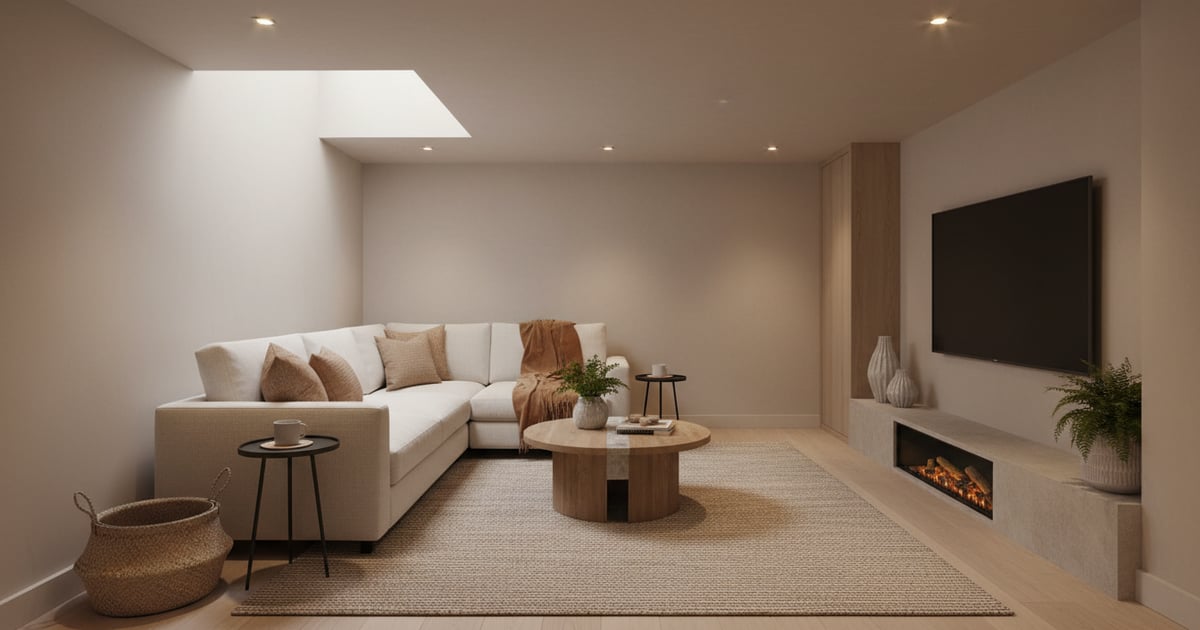
Basement Conversion Cost UK
Estimate YOUR basement conversion cost in 60 seconds — or check an existing quote against fair UK rates.
Estimates based on UK trade benchmark data, updated 2 May 2026. Methodology →
Converting an existing cellar or basement into habitable space is a major project that adds value and square footage. Costs depend on ceiling height, damp proofing (tanking), ventilation, and finish. This guide covers typical UK basement conversion costs in 2026.
Most projects fall between £35,700 and £48,300. Budget refreshes start near £17,100; premium projects reach up to £100,800.
Two ways to take action on basement conversion costs
Pick the path that fits where you are — running early numbers, or pressure-testing a quote you've already got.
Typical UK Cost by Scenario
Typical timeline: 6 to 14 weeksBudget
£25,350
typical figure
- Focused essentials
- Practical finishes
Mid-range
Most common£42,000
typical figure
- Balanced specification with core upgrades
- Reliable materials
Premium
£75,600
typical figure
- Premium materials
- Wider scope with higher coordination demands
Figures are typical UK averages including labour, materials, and VAT at 20% for standard-rated work.
Save money on your quote
Already got a quote from a builder?
Upload it and our AI Quote Checker flags overcharges, missing scope, and the questions worth asking — in about a minute.
Typical UK Cost Ranges for Basement Conversion
| Item | Cost Range |
|---|---|
| Small cellar (tanking + basic finish) | £18,000 – £33,600 |
| Medium basement (full conversion) | £30,000 – £60,000 |
| Large basement (multi-room) | £54,000 – £96,000 |
| Tanking system (per m²) | £240 – £480 |
| Ventilation / sump pump | £1,800 – £4,800 |
| Staircase | £2,400 – £7,200 |
All prices are approximate UK averages including labour, materials, and VAT at 20% (2026). Some qualifying renovations for empty homes may use the reduced 5% VAT rate.
Mini basement conversion cost calculator
Three quick inputs and we'll email you an indicative range. Run the full calculator for a postcode-adjusted estimate.
Real UK Cost Examples
- Budget scenario (bungalow, Sheffield): focused essentials and practical finishes. Not done: major layout or structural changes. Approx cost: £14,250 to £28,000.
- Mid-range scenario (typical homeowner, 2-bed flat): balanced specification with core upgrades and reliable materials. Approx cost: £29,750 to £40,250.
- High-end scenario (3-bed semi): premium materials and wider scope with higher coordination demands. Main cost drivers: specification level and complexity. Approx cost: £42,000 to £84,000.
Related next steps:
What You Can Get For Your Budget
- Around £24,500: core refresh and essential upgrades, usually with no major layout change.
- Around £35,000: balanced refit scope with better materials and targeted performance improvements.
- £52,500+: wider flexibility on finish quality, scope depth, and more complex works.
Hidden Costs to Watch For
- Waterproofing strategy and enabling works can change significantly after surveys.
- Waste removal, making-good, and repeat trade visits are common late-budget increases.
- Compliance and certification items are often missing from initial summary quotes.
- In most UK projects, scope changes after works start are where costs escalate fastest.
Related next steps:
Should You Do This Renovation?
- Usually worth it when basement conversion solves a clear usability, compliance, or energy-performance problem.
- Less worth it when the main issue is cosmetic and resale timing is short-term.
- ROI is strongest when scope is disciplined and specification matches local value levels.
Common Cost Mistakes
- Underestimating labour and preliminaries while focusing only on material prices.
- Changing scope mid-project without budget re-baselining.
- Choosing the cheapest quote without checking detailed inclusions and exclusions.
- Running too little contingency for hidden defects and compliance upgrades.
Key Cost Factors
- Damp proofing — tanking (Type A or C) is essential and costly.
- Ceiling height — low ceilings may need excavation (very expensive).
- Ventilation and drainage — sump pumps and air handling add cost.
- Access — new staircase or altering existing.
- Building regulations — fire, escape, and damp are strictly controlled.
- Location — London and the South East typically cost 20–30% more.
Cost Checkpoints
Use these checkpoints to sequence spend decisions, protect your core scope, and reduce late-stage budget overruns.
- Prioritise large basement (multi-room) first: typical range £54k to £96k can shift the whole project budget if scope changes late.
- Prioritise medium basement (full conversion) next: typical range £30k to £60k can shift the whole project budget if scope changes late.
- Use £35k as a working midpoint and hold a contingency of roughly 10% to 15% for unknowns and making-good works.
- Request like-for-like quotes with labour, materials, and exclusions split out so you can compare options without hidden scope gaps.
5 line items every fair basement conversion quote should include
Use this checklist to spot missing scope before you sign — each item names what should be priced and what to ask for if it isn't.
- 1
Structural engineer + Building Regs Full Plans
Basements are heavily regulated. You need: IStructE-registered engineer for underpinning calcs (if lowering floor or new dig), retaining wall design, Building Regs Full Plans submission (NOT Building Notice — basements are too risky for short-form), Party Wall Awards if attached.
Fair UK range: £3,000-£8,000 engineering fees; £600-£1,500 Building Control fees; £700-£1,500 per party wall surveyor.
Ask: Are structural engineer fees, Building Regs Full Plans, and Party Wall Awards itemised separately?
- 2
Waterproofing system — Type A, Type C, or combined (BS8102 compliant)
BS8102:2022 specifies waterproofing for habitable basements. Type A (tanking — barrier against water) and Type C (cavity drainage — manages water that gets through) are both options. For habitable space, BS8102 recommends DUAL systems (A + C combined). Single-system warranties are weaker.
Fair UK range: Type A £80-£150/m²; Type C £100-£200/m²; combined £180-£350/m². Drainage pump system £1,500-£3,000.
Ask: Which waterproofing system are you using, and is it dual (A + C) per BS8102 best practice for habitable space?
- 3
Underpinning + structural shell (if lowering or new dig)
Lowering existing basement floors or new digs requires underpinning the existing house foundations — supporting them while you dig down beneath. This is high-risk, high-cost work. Sequenced carefully (1m sections at a time), requires structural engineer supervision.
Fair UK range: £1,500-£3,500/m² for underpinning alone. New dig with underpinning: £3,000-£5,000/m² total.
Ask: Is underpinning needed, what's the sequence/methodology, and is engineer site supervision included?
- 4
Egress + light wells (Building Regs Part B + Part O)
Habitable basement rooms need: emergency escape route (Part B fire) — typically a window large enough to climb through, with a light well and ladder if below ground level; adequate daylight (Part O) — usually requires light wells or sun pipes. These are non-negotiable and often forgotten in cheap quotes.
Fair UK range: £3,000-£8,000 per light well/escape window depending on construction.
Ask: What's the egress route for fire escape, and how do you meet Part O daylight requirements?
- 5
Mechanical ventilation + dehumidification
Basements are below DPC level — they need active ventilation. MVHR (Mechanical Ventilation with Heat Recovery) is best practice but expensive (£3,000-£8,000). Cheaper: extract fans + heat sources to keep humidity below 60%. Without proper ventilation, basements feel damp and grow mould.
Fair UK range: £2,000-£5,000 for proper ventilation system; £6,000-£12,000 for full MVHR.
Ask: What ventilation system are you proposing, and what humidity targets does it maintain?
Want this run on your actual basement conversion quote? Upload it and our AI Quote Checker flags missing line items, overcharges and the questions worth asking.
7 red flags that mean you might be overcharged on a basement conversion quote
UK-specific signals — each red flag explains why it matters and the question that surfaces the truth.
Single waterproofing system on a habitable basement
Why it matters: BS8102:2022 specifies dual systems (Type A + Type C) for habitable basement space. Single-system installations have higher failure rates and weaker warranty protection. Reputable specialists default to dual systems.
Ask: Are you using BS8102-compliant dual waterproofing (Type A + Type C) for this habitable conversion?
PCA non-membership claiming 'specialist' status
Why it matters: PCA (Property Care Association) is the UK industry body for basement and damp specialists. Non-PCA contractors lack the methodological standard and often make critical errors. Their warranties also don't qualify for IBG via the GPI (Guarantee Protection Insurance) scheme.
Ask: Are you a PCA member, and what's your PCA registration number?
No structural engineer named on the quote
Why it matters: Underpinning or new dig basements without proper structural calcs are dangerous. Houses have collapsed during cowboy basement conversions. The engineer should be IStructE-registered, named, and have current PI insurance.
Ask: Who is the structural engineer, are they IStructE-registered, and can you share their PI certificate?
Quote significantly below £2,500/m² for new dig
Why it matters: UK 2026 typical for new-dig basement is £3,500-£5,500/m² (London: £4,500-£7,000/m²). Below £2,500/m² usually means: no proper waterproofing, no structural engineer supervision, no Party Wall Awards, single waterproofing system. The conversion will fail at 5-10 years.
Ask: How are you achieving this price? What waterproofing system, structural supervision, and Party Wall provision is included?
No Party Wall Awards mentioned for attached property
Why it matters: Basement work on attached homes ALWAYS triggers the Party Wall etc. Act 1996 (because of underpinning that affects neighbour foundations). Awards take 6-12 weeks and cost £1,500-£3,000. A contractor who doesn't mention them is either inexperienced or hoping you won't notice — until your neighbour serves an injunction.
Ask: Have you allowed for Party Wall Awards with all neighbours, including timing (6-12 weeks before work can start)?
No GPI/IBG warranty on waterproofing system
Why it matters: Basement waterproofing failure costs £20,000-£100,000+ to remediate. Reputable PCA specialists offer 10-year insurance-backed waterproofing warranties via GPI (Guarantee Protection Insurance). Without IBG, your warranty dies with the contractor.
Ask: Is the waterproofing warranty insurance-backed (GPI or similar)? What's the warranty duration and what does it cover?
No mention of light wells, sun pipes, or escape window
Why it matters: Habitable basements require escape route (Part B) and daylight (Part O). Basements without these provisions can't be Building Regs signed off as habitable. The contractor either doesn't know or is hoping to skip — either way, the conversion will fail Building Control.
Ask: What's the escape route for fire (Part B), and how do you meet daylight requirements (Part O)?
Spot a couple of these on your basement conversion quote? Upload it for a full red-flag scan and fair-rate comparison.
How to negotiate a basement conversion quote
A simple framework, a verbatim script you can paste into an email or text, and the topic-specific levers that move the price.
Framework
- 1Get three quotes from PCA-registered basement specialists (verify on property-care.org). Specify: same conversion type (convert existing / lower floor / new dig), same area, same waterproofing system (single Type A vs dual A+C), same use (habitable bedroom vs gym/storage). Without identical scope, quotes can't be compared.
- 2Demand itemised breakdowns covering: structural engineer, Party Wall Awards, Building Regs, underpinning, waterproofing system, drainage pumps, light wells/egress, ventilation, fit-out. Reject single-total quotes — too easy to skip waterproofing layers or Party Wall.
- 3Identify the median per major line. The total spread on basements is enormous (often £30-£80k across three quotes) — meaningless. The line-item spread shows you who's lowballing waterproofing or Party Wall.
- 4Insist on a JCT contract with specific basement clauses: stage payments tied to milestones (engineer's report received, underpinning complete, waterproofing first inspection, completion), retention 5-10% held back 12 months, GPI-backed warranty registered to property.
Verbatim script
I've had three quotes for this basement conversion. Yours is competitive overall, but the waterproofing line is £X above the median I've received from two other PCA-registered specialists, and the structural line is £Y below. The other quotes specify dual Type A + Type C waterproofing per BS8102 best practice. Can you walk me through your waterproofing approach, confirm the spec is BS8102-compliant for habitable use, and is the warranty GPI-insured?
Topic-specific levers
- Use type: 'storage / utility room' use is much cheaper than 'habitable bedroom' (lower waterproofing spec, no Part B/O compliance). Decide use carefully.
- Existing cellar conversion: if existing cellar has 1.8m+ head height, conversion is dramatically cheaper than lowering or new dig (£1,500-£2,500/m² vs £3,500-£5,500/m²).
- Self-supplied finishes: source flooring, decoration, lighting, sanitaryware yourself. Saves 20-30% on fit-out.
- Phased completion: shell + waterproofing + ventilation done by specialist; final fit-out by separate trades. Spreads cost and protects waterproofing warranty (a good specialist won't warranty a basement someone else fits out badly).
- Combine with planned extension: if extending the house anyway, basement work can share scaffolding, site setup, and Party Wall coordination.
Want to know which line items on your basement conversion quote are above market before you negotiate? Upload it for a fair-rate comparison.
10 questions to ask before hiring a PCA-registered basement specialist
Vet on competence, insurance, paperwork and process — not price alone. Each question spells out the answer you want and why.
1. Are you a PCA (Property Care Association) member, and what's your registration number?
Why it matters: PCA is the UK industry body for basement and damp specialists. Membership requires assessed competence and adherence to standards. Verifiable on property-care.org.
2. Can you show me 2-3 completed basement conversions from the last 18 months, with homeowner contact details?
Why it matters: Basements are bespoke and complex. Recent local references let you visit completed work, view the waterproofing inspection records, and ask homeowners about post-build experience (especially humidity and any leaks).
3. Who's your structural engineer, are they IStructE-registered, and what's their basement experience?
Why it matters: Basement engineering is a specialism within structural engineering. Generalist engineers may miss critical issues. Ask for the engineer's specific basement portfolio.
4. What waterproofing system are you specifying, and is it BS8102-compliant for habitable use?
Why it matters: BS8102:2022 specifies dual systems (Type A + Type C) for habitable space. Single-system specifications are sub-standard for habitable basements.
5. Is the waterproofing warranty insurance-backed via GPI (Guarantee Protection Insurance)?
Why it matters: GPI is the standard insurance-backed warranty for basement waterproofing. 10-year cover survives if the contractor goes bust. Non-GPI warranties are worthless after contractor failure.
6. Have you priced for Party Wall Awards, and how long does that add to the programme?
Why it matters: Party Wall on basements is mandatory for attached property and adds 6-12 weeks before work can start. Reputable contractors price and programme this; cowboys hope you'll waive it.
7. What contract are you proposing — JCT Minor Works, JCT Standard Building, or your own?
Why it matters: Basement projects are six-figure jobs. JCT Minor Works (for £30k-£200k) or JCT Standard Building (>£200k) is essential. Your own terms = your problem if disputes arise.
8. What's your payment schedule, and what milestones trigger each stage?
Why it matters: Stage payments tied to verifiable milestones (engineer's report received, Party Wall Awards in place, underpinning complete, waterproofing first inspection passed, completion) protect you. 5-10% retention held back 12 months is industry norm.
9. What public liability and PI insurance do you carry, and at what level?
Why it matters: Basement work is highest-risk in domestic construction. £5M minimum public liability is standard; PI insurance for the contractor (separate from engineer's PI) covers design-related claims.
10. Are you VAT registered, and will you provide a proper invoice?
Why it matters: VAT registration matters for £50k+ projects — for invoice and warranty enforcement. Cash-only or no-invoice arrangements forfeit consumer protection.
Already chosen a PCA-registered basement specialist and got a quote? Run it through our Quote Checker before you commit.
Typical Timeline
| Item | Duration |
|---|---|
| Small cellar conversion | 6 to 10 weeks |
| Medium basement | 8 to 12 weeks |
| Large or complex basement | 10 to 14 weeks |
Regional Cost Variations
Basement conversions in London are very common and costly — often 20–30% above national averages. Specialist damp and tanking firms are essential.
Costs in your area
Compare regional benchmarks for basement conversion using the same UK baseline assumptions.
Ways to Reduce Costs
- Use the existing cellar if head height is sufficient — excavating down is very expensive.
- Get specialist damp and tanking quotes — don't rely on a general builder alone.
- Plan ventilation and escape routes early for building regs.
- Consider use — a cinema or utility room may need less finish than a bedroom.
Ready to act on your basement conversion project?
Whether you're still scoping or already comparing builders, the next step is one click away.